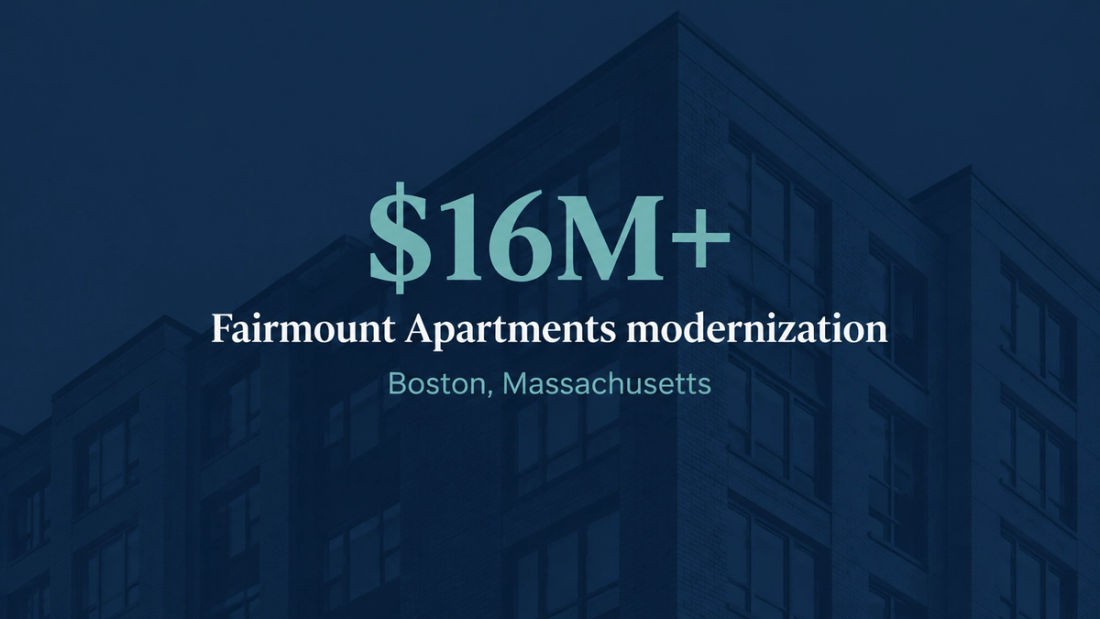
Boston Announces More Than $16 Million for Fairmount Housing Upgrades
Planned work at the public housing community pairs heating and hot water electrification with cooling, accessibility upgrades and stormwater improvements.


OperationsData Report
Package volume is now a daily operations problem. Locker systems can reduce staff burden, but capacity planning has to account for holiday peaks and oversized deliveries.
So what: For most properties, the question is no longer whether packages need dedicated infrastructure. It is whether locker capacity, overflow space, and pickup rules match actual delivery demand.
Package delivery has quietly become one of the more operationally demanding parts of running a multifamily property.
It used to be a front-desk inconvenience: a few boxes, a sign-in sheet, maybe a back room with shelving. Today, delivery volume can consume leasing-office time, crowd common areas, create security exposure, and produce resident frustration when packages cannot be located or retrieved outside office hours.
That has changed package lockers from a nice amenity into close to a baseline operational system for many properties.
The important question for operators is no longer simply whether to install lockers. It is whether the property has the right amount and type of delivery infrastructure for its actual volume—including the seasonal weeks when normal capacity breaks down.
The most widely cited multifamily benchmark remains the National Multifamily Housing Council’s 2018 Package Delivery Survey, conducted with Kingsley Associates. It covered 2,098 properties in 44 states and found that the average apartment community handled roughly one package per unit per week. NMHC’s package-delivery infographic puts that benchmark in even simpler terms: one package per unit, per week.
For a 250-unit property, that is approximately 250 packages in an average week before holiday demand, promotional sales events, move-ins, grocery delivery, meal delivery, or oversized items are considered.
Volume also does not stay flat.
A Multi-Housing News analysis of the same industry data reported that the average community received about 150 packages a week, rising to about 270 packages a week during the holiday season—an 81 percent increase. The difference between those figures and the NMHC per-unit benchmark reflects the wide variation in community size, geography, resident demographics, and delivery behavior. The operational lesson is the same: package capacity designed around an average week can fail during the busiest period of the year.
The original survey also included individual examples that make the scale more concrete. One 165-unit upscale property in the Dallas area received 585 packages per month, while a 740-unit property nearby received about 1,800 monthly packages. Annual volume at the larger property, adjusted for holiday demand, ran from roughly 21,000 to 24,000 packages. NMHC Package Delivery Survey
That volume is no longer an occasional burden for onsite teams. It is recurring property infrastructure demand.
The operational problem is not just total package volume. It is variability.
A package room or locker bank can appear sufficient for most of the year and still become unusable during the few weeks residents need it most. Black Friday, Cyber Monday, December holiday shopping, Prime Day, move-in periods, and local weather disruptions can all compress delivery volume into a short period.
CNBC reported that Luxer One saw an 83 percent increase in deliveries to its lockers in the week after Black Friday and Cyber Monday compared with the prior week. The company also reported a 44 percent year-over-year increase in November delivery volume and a 112 percent increase in oversized-locker deliveries after Thanksgiving weekend.
Those are vendor-specific figures rather than an industry-wide benchmark. Still, they illustrate the planning problem well: a locker system sized only for normal weekly demand can run out of usable space exactly when delivery traffic is most intense.
Luxer One’s more recent holiday data makes the same point. The company reported a 16 percent increase in total deliveries from 2024 to 2025, a 27.2 percent jump from November to December 2024, and peak daily delivery volumes reaching up to 2.5 times a community’s usual average during holiday periods. Black Friday for Multifamily: How Property Managers Can Prepare
For operators, that means locker capacity should be based on more than the number of units or average daily deliveries. It should account for package dwell time, pickup behavior, carrier schedules, holiday surges, oversized packages, and a defined overflow plan.
Residents and operators have generally converged on the same answer: self-service lockers are the preferred package-delivery model.
In the NMHC/Kingsley survey, 57 percent of community managers identified package lockers as the best way to deliver packages to residents. That was well ahead of resident-accessible package rooms at 13 percent, delivery directly to the resident’s door at 12 percent, holding packages in a management office or non-accessible room at 11 percent, and staff delivery to units at 1 percent. NMHC Package Delivery Survey infographic
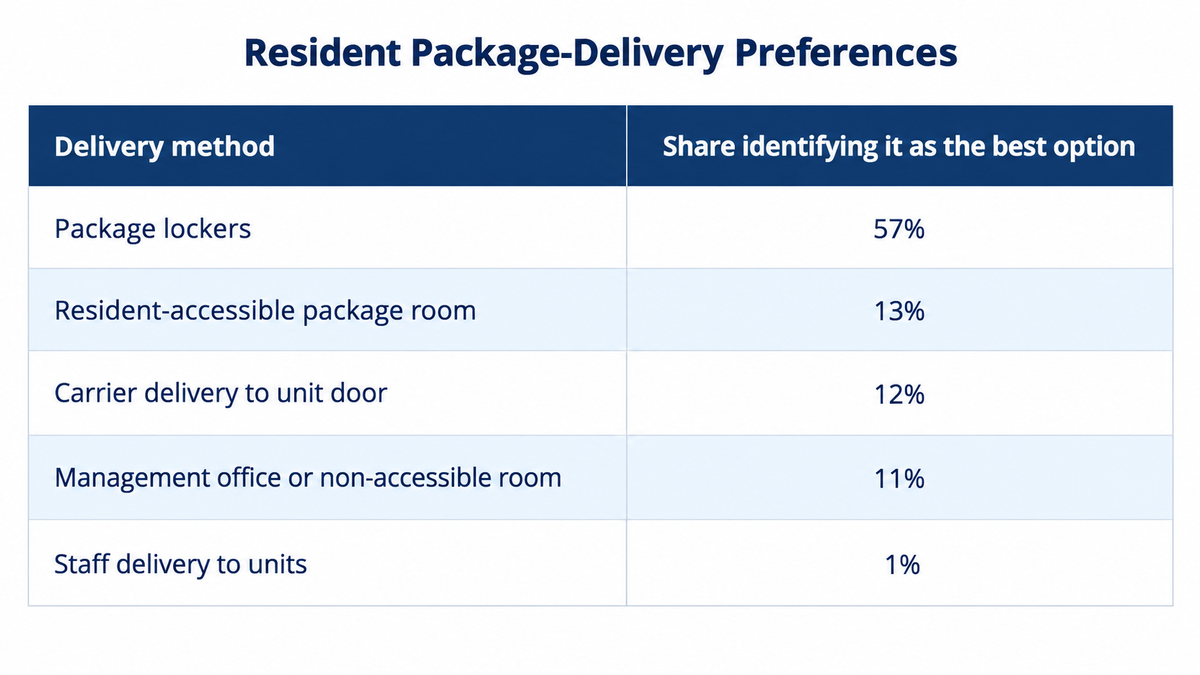
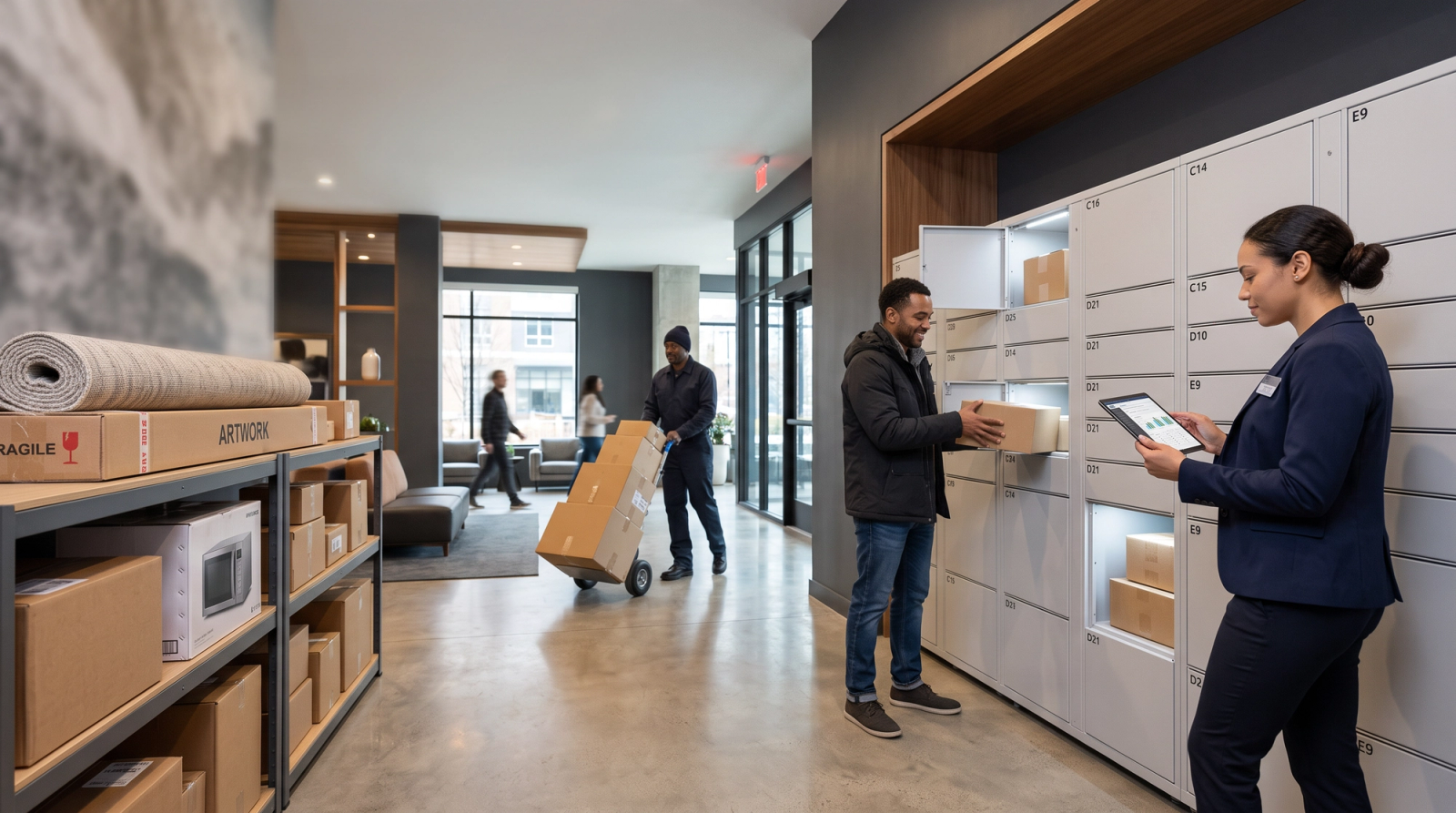
The preference is understandable. Lockers offer a secure chain of custody, allow residents to retrieve packages on their own schedule, and reduce the need for staff to sign, sort, store, notify, and release individual deliveries.
But the survey also found a gap between preference and adoption. Fewer than half of responding communities were actually using package lockers at the time. NMHC Package Delivery Survey infographic
That gap likely narrowed as package volume continued to rise, but it remains relevant for older properties and properties still relying on a staffed leasing office or an open package room.
Manual package management looks small on a per-package basis. It becomes expensive when multiplied by hundreds of deliveries each month.
Parcel Pending, a locker-system vendor, has said that handling 15 packages manually can consume about one staff hour. Its customer-reported estimates say electronic lockers can save property-management teams between 14 and 28 staff hours a week and up to $1,200 a week in operating costs. Property Managers Saving Up to 28 Hours and $1,200 Per Week With Parcel Lockers
Those are vendor-reported figures, not a guaranteed outcome for every asset. They should be treated as directional.
Still, the underlying math is hard to ignore. A property receiving 600 packages a month may not be able to absorb manual receiving, storage, resident notifications, pickup coordination, carrier questions, lost-package disputes, and overflow management without taking time away from leasing, maintenance coordination, renewals, and resident service.
The operational cost is especially visible when the package room is not resident-accessible. Every pickup requires a staff member to be available. Every late arrival becomes a resident-access issue. Every mis-shelved box turns into a search. And every holiday surge turns back-office space into a temporary logistics operation.
Small parcels are not the only issue.
Operators increasingly have to accommodate furniture, appliances, artwork, large-format retail purchases, grocery orders, and other deliveries that do not fit a standard locker compartment. A property can have plenty of lockers on paper and still lack a workable system if its only available spaces fit shoebox-sized parcels.
This is pushing the infrastructure conversation beyond a simple locker count.
Properties need to consider:
The 2018 NMHC survey found that only 4 percent of community managers had refrigerated lockers, but 43 percent of those with them said they were used daily. Multi-Housing News This is not an argument that every community needs refrigerated capacity. It is evidence that delivery types are diversifying, and a one-size-fits-all locker bank may not match resident behavior.
For properties still relying on a staffed package room, the case for automation is usually not difficult to make.
The harder question is whether the proposed system is properly sized.
A locker installation that handles average daily volume but fills up during holiday peaks simply moves the problem from the leasing office to an overflow area. Likewise, a system with many small lockers but limited oversized capacity can create a separate manual workflow for the deliveries that take up the most space.
Before selecting or expanding a system, operators should document actual conditions for at least 60 to 90 days, then test that data against seasonal demand.
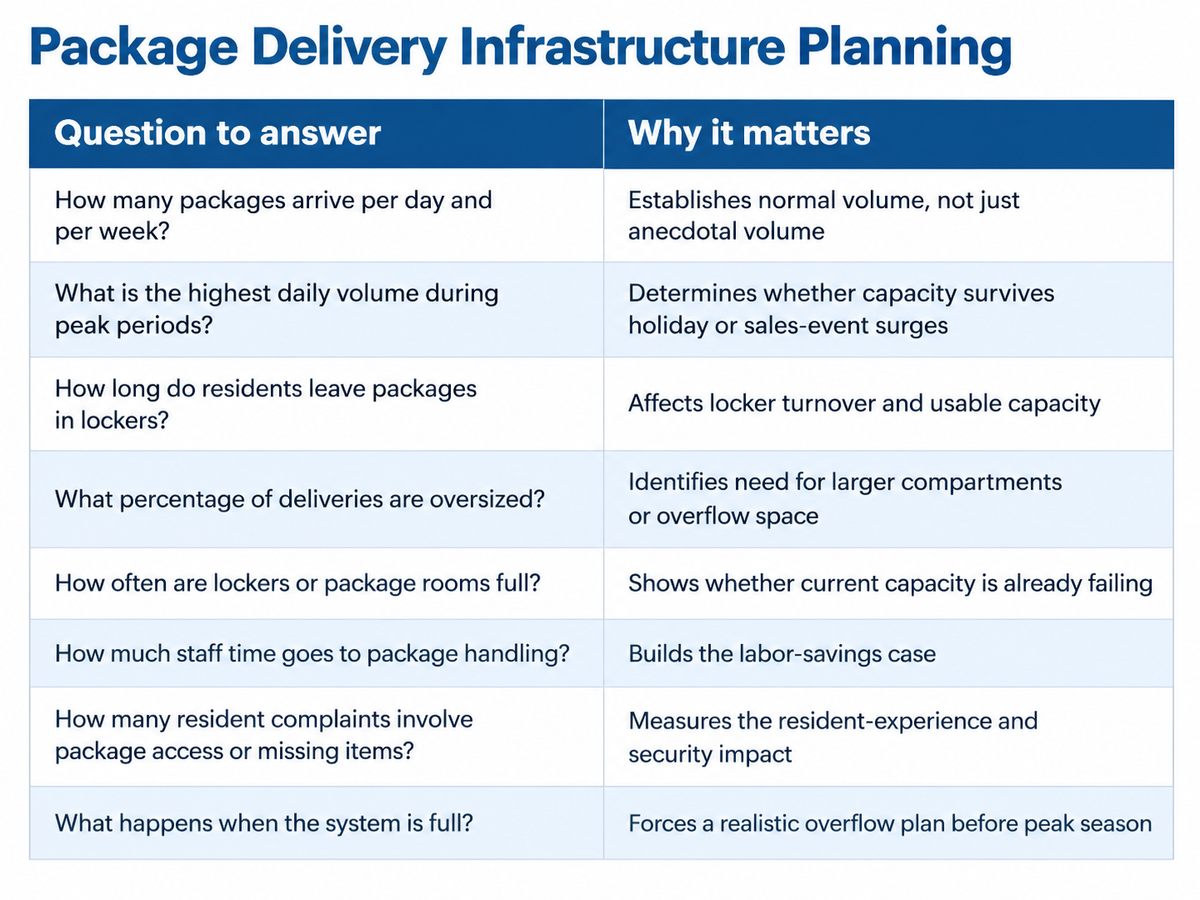
The best locker program is not necessarily the largest system. It is the system that matches actual delivery behavior, turns capacity quickly, accommodates the property’s package mix, and has a credible overflow plan.
Package delivery is no longer a peripheral resident amenity issue.
It is a recurring logistics function that affects leasing-staff workload, resident convenience, building security, and common-area operations. The industry data makes a clear case that residents prefer self-service package lockers, while holiday spikes and growing oversized-delivery demand make capacity planning more important than ever.
For many properties, the decision is no longer whether package automation makes sense.
It is whether the current infrastructure is sized for the days when it matters most.
Planned work at the public housing community pairs heating and hot water electrification with cooling, accessibility upgrades and stormwater improvements.
A closed ticket does not prove a lasting repair. Auditing repeat requests helps operators distinguish unresolved problems, recurring failures, and planned follow-ups.
A completed work order does not authorize move-in. A clear handoff between maintenance, management, and leasing makes unit readiness a documented decision.