Rental Fee Rules Reset in 2027 as Illinois and Seattle Join Colorado
Illinois and Seattle have set 2027 start dates for rental fee limits and upfront disclosure, and Colorado’s rules already apply. Fee schedules now need a compliance owner.
So what: In any market you operate, check each fee and your listing totals against these rules now. Illinois starts January 1, Seattle July 1, and the FTC is still studying a national rule.
AI-generated illustration of a leasing office desk; not a depiction of a specific property, company or jurisdiction.
Rental fees used to be a lease template problem. Someone in legal reviewed the fee schedule once a year, the leasing team quoted base rent, and the extras surfaced in the application portal or on page 14 of the lease. Three jurisdictions have now made that arrangement hard to defend, and they went about it in three different ways. A portfolio that touches more than one of them will need to treat the fee schedule as a live compliance document that reaches advertising, software settings and renewal workflows.
Colorado regulates the price you advertise
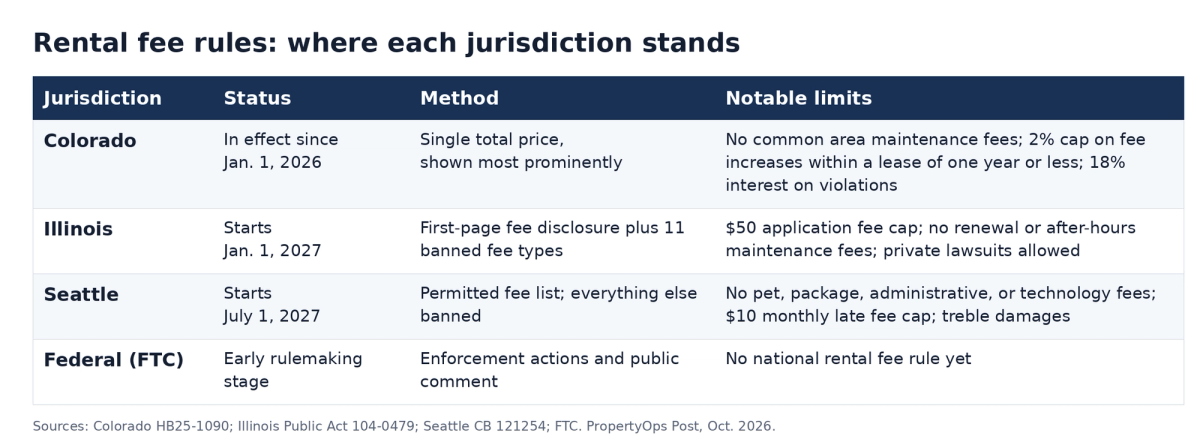
Colorado’s HB25-1090 took effect January 1, 2026. It bars any seller, landlords included, from advertising a price unless the total price appears as a single number, disclosed more prominently than any other pricing information. The session law defines total price as the maximum a person must pay, including amounts that are not reasonably avoidable. Government charges are excluded, and a landlord does not have to fold the utility provider’s actual charge into the number.
The law also reaches into what landlords can bill. Per the same session law, a tenant cannot be required to pay a fee for common area maintenance, for property taxes, for something the landlord must provide anyway to keep the unit habitable, or for a service not actually provided. A fee on a lease of one year or less cannot rise more than 2 percent during the term, utilities excepted. Payment processing fees are barred when a free way to pay is not reasonably accessible to the tenant.
Enforcement has a fast clock. A tenant can send a written demand, and a landlord that refuses to stop charging within 14 days owes actual damages plus 18 percent interest compounded annually, according to the legislature’s bill summary.
Illinois regulates the lease and names the banned fees
Illinois signed its law first. Public Act 104-0479, the HB 3564 junk fee law, was approved June 26, 2026, and a companion bill moved its start from July 1, 2026 to January 1, 2027.
Every nonoptional fee, one time or recurring, has to appear on the first page of the lease, and a tenant owes nothing that is missing from it. The same fees must be clear and conspicuous in the listing or an accompanying weblink, along with whether utilities are included in rent. The act then lists eleven categories landlords cannot charge, among them fees for lease renewals or modifications, after-hours maintenance requests, contacting the manager about a repair or lease question, maintenance travel, hotline calls, routine upkeep, and move-in or move-out walkthroughs. Pest control is off the table when the tenant did not contribute to the infestation. Application fees, background checks included, cap at $50 unless the real third-party cost is higher, the landlord pays that vendor first, and the applicant is billed within 14 days with receipts. Miss the 14 days and the extra charge is waived.
A landlord cannot rename a banned fee to escape the act. Local governments may regulate fees only if they are at least as strict. Tenants can sue for injunctions, money, and attorney’s fees. Owner-occupied buildings with six units or fewer are exempt. Illinois Legal Aid describes the cutoff as leases starting on or after January 1, 2027, while the statute’s text says leases entered into after the effective date, so treat January 1 as the safe line for templates.
One caution on sourcing. Some summaries describe late fee caps and a move-in fee limit as part of the law. Those provisions appeared in earlier versions of the bill but do not appear in the enacted text.
Seattle flips the default
Seattle’s ordinance (Council Bill 121254) passed the City Council on August 11, 2026, and applies to agreements entered into or renewed after July 1, 2027. The Multifamily Dive report puts the vote at 8-0.
Where Colorado lists what is prohibited, Seattle lists what is allowed and bans everything else. The city’s fee guidance caps the security deposit plus move-in charges at one month’s rent, allows a pet damage deposit up to 25 percent of rent, late fees up to $10 a month, parking, utilities, documented tenant damage, and a short list of capped lockout, key, and returned payment charges. Pet fees, package fees, administrative fees, technology fees, lease renewal fees and lease signing fees are among those named as prohibited. Optional services stay legal if the tenant opts in in writing, can opt out at no cost, and pays no more than the landlord’s cost for third-party services.
Listings, advertisements, and applications must show rent, mandatory and optional fees, utilities, concessions, and an average total monthly cost with estimates for variable fees. Records must be kept for three years. The Department of Construction and Inspections gets enforcement authority on July 1, 2027, and the city says the City Attorney and tenants can also sue. The mayor’s office says the City Attorney can recover three times the illegal fees.
Seattle’s own guidance says fees of this kind can add 10 to 30 percent on top of rent. That is the city’s claim, not an independent measurement.
In March the FTC asked for public comment on whether a rental fee rule is needed. That is an advance notice, the earliest stage, so no federal rule is imminent. State and city rules are the ones with dates attached.
Start with the fee schedule, then the software
Pull every charge a resident can see, from application through move-out, and sort each into mandatory, optional, or something you cannot defend in your strictest market. Then check how your property management system and listing feeds display the total. The FTC letters put software behavior in the frame, and a total price that is correct in the lease but wrong on a syndicated listing is still a listing problem.
Illinois leases need first-page fee tables and a new application fee workflow before January 1. Seattle operators have until July, and the city says a landlord may keep charging a now-prohibited fee until the existing lease term ends or July 1, 2027, whichever is later, so renewal calendars matter as much as the start date. Operators in Colorado should treat the 2 percent cap and the payment processing rule as ongoing audit items. Elsewhere, Clark Hill counted more than 20 states with laws addressing rental fees as of September 2025, which makes the audit worth doing even outside these three markets.
HUD will move Emergency Housing Voucher families leased as of Sept. 30 onto Tenant Protection Vouchers by year end. PHAs have until Oct. 15 to correct HUD’s award estimates.
California lawmakers have sent AB 2050 to Gov. Gavin Newsom, requiring financially underfunded associations to strengthen 30-year reserve planning beginning in 2032.