
Before Approving the Replacement, Can You Find the Warranty?
A failed water heater puts warranty records to the test. Before approving the estimate, property managers need to know what is covered and what the property will still pay.


OperationsAnalysis
Completed work orders do not always mean move-in-ready apartments. A management framework helps operators identify the delay that deserves attention first.
So what: Before adding staff or software, trace where apartments wait. Fixing a recurring handoff or approval delay may matter more than increasing individual output.
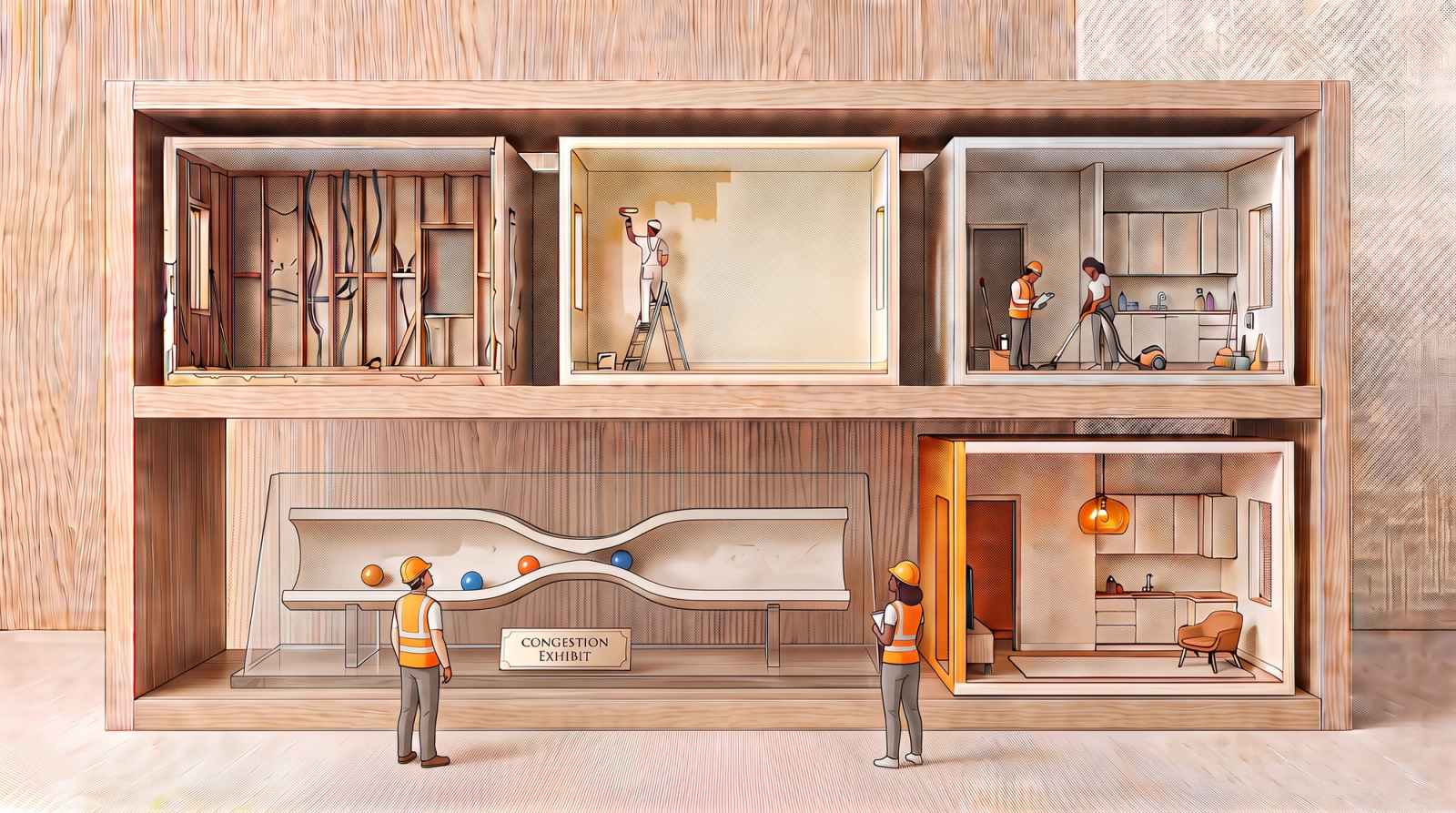
The repairs are done. The painting is finished. The apartment is clean.
But it is not ready for a resident.
At this hypothetical community, several apartments are waiting for final inspection. Technicians continue closing work orders elsewhere. Leasing continues handling inquiries. The property manager asks both teams to move faster.
The activity increases. The inspection backlog does not shrink.
The problem is not necessarily anyone’s effort. It is that improving the work before a bottleneck does not automatically move more apartments through it.
That distinction is central to the Theory of Constraints, a management framework developed by Eliyahu Goldratt. Its premise is that an operation’s results are limited by a constraint, and improvements elsewhere may do little to change those results.
For multifamily teams, the framework offers a different starting point for slow turns: follow the apartment, not just the work orders.
An individual productivity measure answers an individual question. How many repairs did a technician finish? How many apartments did a painter complete?
It does not necessarily answer the property manager’s question: How many apartments became ready for occupancy?
Consider a unit that needs repairs, painting, cleaning, and final inspection. Completing three stages does not make it ready if the fourth remains outstanding. Increasing output at an earlier stage may simply leave more apartments waiting downstream.
The Theory of Constraints Institute illustrates this problem with work piling up between processes: making one function more productive can increase unfinished work without improving the operation’s overall output.
Applied to apartment turns, the implication is not to abandon task-level reporting. It is to pair those numbers with a clear view of what remains unfinished and why.
Start with a manageable group of recent turns, including ordinary apartments and unusually difficult ones. Keep those categories distinguishable so a major renovation does not distort the picture of a routine turn.
For each apartment, record:
Use consistent definitions. If one team marks a unit “ready” when repairs end and another waits until cleaning and inspection are complete, their numbers will not describe the same outcome.
Then separate time spent working from time spent waiting.
A two-hour repair might sit behind a three-day approval delay. A finished paint job might wait several days for cleaning. An apartment might miss an inspection because a required item was not complete.
Those situations call for different responses. “Maintenance takes too long” is not a diagnosis.
Look for a recurring queue, then investigate what causes it. The Theory of Constraints Institute identifies accumulated work as a useful clue, while also recognizing less obvious constraints such as skilled labor, inspection approvals, and purchasing policies.
A queue alone does not establish the cause. Apartments listed as “awaiting inspection” may actually be awaiting unfinished repairs.
Goldratt’s five focusing steps provide a sequence: identify the constraint, use its existing capacity effectively, coordinate other work around it, expand capacity when necessary, and reassess when the constraint changes.
Here is how that sequence could apply to the hypothetical inspection backlog.
Review the apartments waiting for inspection. Are they genuinely complete? Are missed appointments or failed inspections extending the delay?
Establish whether inspection availability repeatedly determines when apartments become ready. Do not reorganize the process around a status label that hides another problem.
If inspection availability is the constraint, examine how that time is used.
Possible changes to test include protected appointment windows, clearer notification that a unit is ready, and a pre-inspection checklist to catch incomplete items before the inspector arrives.
The objective is fewer wasted appointments, not less thorough inspections.
Schedule repairs and cleaning so completed apartments can reach their inspection appointments.
That requires a shared sequence and clear ownership of handoffs. Separate departmental schedules may each look efficient while failing to produce ready apartments.
This is also where a manufacturing-derived framework needs limits. Emergency repairs, resident safety, and required maintenance obligations must remain priorities. Vacant-unit scheduling should not displace them.
If better preparation and coordination do not resolve the backlog, additional qualified inspection capacity may be warranted.
The framework does not rule out hiring or contracting. It asks managers to examine existing capacity before expanding it.
Nor should that sequence become a reason to postpone an evident staffing need. A process review is a diagnostic tool, not proof that the current team can absorb more work.
Once inspection delays decline, materials, vendors, or another stage may determine turnaround time. Recheck the process rather than continuing to optimize the old bottleneck.
Keep turn performance separate from leasing performance. An apartment that is ready but unleased presents a different problem from one that cannot yet be occupied.
The most useful intervention may happen before the turn starts.
In a February 2021 National Apartment Association article, Chad Moulin, then vice president of facilities for GK Management, described using pre-move-out inspections to identify materials, vendor needs, and staffing requirements before an apartment became vacant. The article reported his findings from research covering 385 communities and more than 73,000 apartment homes.
That is an operational example of earlier planning, not evidence that the communities implemented the Theory of Constraints.
The distinction matters. The framework supplies a way to investigate delays; the NAA reporting illustrates a multifamily practice that could address some of them. Neither establishes that every property has the same bottleneck or will achieve the same result.
Where permitted and conducted in accordance with applicable entry requirements, an earlier inspection could help a team discover a long-lead replacement before it becomes an urgent vacant-unit purchase.
A purchasing rule deserves similar scrutiny. If routine replacements wait days for authorization, review whether approved specifications and appropriate spending limits could reduce the delay without weakening financial controls.
Choose one recurring delay and one intervention. Name an owner, document the change, and compare similar turns before and after it.
Track total turn time, waiting time at the targeted stage, apartments queued there, and final inspections passed without rework. Review occupied-resident service backlogs and overtime alongside those measures.
Interpret the results together:
Treat a small pilot as directional evidence, not a guaranteed financial return. Apartment condition, workload, and changes in available staffing can complicate the comparison.
The next discussion about turn times should include more than a total-days figure or a list of completed tasks.
Bring a timeline. Identify where apartments repeatedly stopped moving. Establish whether they were ready for the next step, who owned the handoff, and what prevented it from happening.
Then test a specific change.
A request to work faster leaves everyone to interpret the problem. A documented delay gives the team something it can fix.
A failed water heater puts warranty records to the test. Before approving the estimate, property managers need to know what is covered and what the property will still pay.
ResiHome will manage Southern Waters Capital’s new Florida rental community, with a public grand opening scheduled for November 16.
Treplus, Greystar, United Plus and Sparrow Living show how leasing, staff training and resident participation shape active-adult property operations.
![keeping the realistic image and the PropertyOps Post identifier unchanged. Let's apply that semibold font to the full layout generated-image.png I meant the semibold serif treatment generated-image.png Now publish the final draft of the brief to Sanity. I will upload the image Create the final ResiHome brief as a Sanity draft in PropertyOps production, without an image for you to upload? text {"projectId":"cypelnwv","dataset":"production","documents":[{"type":"article","content":{"title":"ResiHome to manage SoLiv Panama City townhomes","slug":{"_type":"slug","current":"resihome-to-manage-soliv-panama-city-townhomes"},"dek":"ResiHome will manage Southern Waters Capital’s new Florida rental community, with a public grand opening scheduled for November 16.","soWhat":"Track ResiHome’s new management assignment as SoLiv Panama City begins leasing ahead of its scheduled November 16 opening.","contentType":"news","beat":{"_type":"reference","_ref":"beat-operations-amenities"},"sectors":[{"_key":"sfr","_type":"reference","_ref":"sector-sfr-btr"}],"authors":[{"_key":"news","_type":"reference","_ref":"d4765a47-dc48-4f4d-8a6a-4ac50f55226f"}],"publishedAt":"2026-11-06T22:45:00Z","body":[{"_key":"p1","_type":"block","style":"normal","markDefs":[{"_key":"source","_type":"link","href":"https://www.prnewswire.com/news-releases/resihome-partners-with-southern-waters-capital-to-manage-new-build-to-rent-community-in-panama-city-fl-302925297.html"}],"children":[{"_key":"s1","_type":"span","marks":[],"text":"ResiHome has been selected to manage SoLiv Panama City, a new build-to-rent townhome community developed by Southern Waters Capital in Panama City, Florida, according to the company’s "},{"_key":"s2","_type":"span","marks":["source"],"text":"November 2 announcement on PR Newswire"},{"_key":"s3","_type":"span","marks":[],"text":"."}]},{"_key":"p2","_type":"block","style":"normal","markDefs":[],"children":[{"_key":"s4","_type":"span","marks":[],"text":"The community at 2316 Fortune Ave. is leasing three-bedroom townhomes with two-and-a-half bathrooms. ResiHome will provide property management services, including leasing technology, maintenance and reporting."}]},{"_key":"p3","_type":"block","style":"normal","markDefs":[],"children":[{"_key":"s5","_type":"span","marks":[],"text":"A public grand opening is scheduled for November 16. Executives from both companies said they expect to work together on additional communities, though the announcement did not identify other properties."}]}],"noteToEditors":"Final brief. User will upload the header image. Leave as draft until image is added; publication requires a separate publish action."}}]} Reply yes to proceed or no to cancel. yes Saved in Sanity as a draft titled “RClipboard and pen on a desk overlooking residential buildings, with the heading “Management contracts” and PropertyOps Post branding.](https://cdn.sanity.io/images/cypelnwv/production/5db82f438cdf0b41f0a420d33f3f800436ae6ee9-1672x940.png?w=1100&auto=format)