Before You Renew Your Property Software: Can You Get Your Data Out?
Before renewing property software, test what you can retrieve. Downloadable reports do not establish that your records are complete, usable, or ready for another system.


TechnologyAnalysis
Automation makes resident operations faster and cheaper. But when it replaces human judgment in high-stakes moments, efficiency gains can come at the expense of trust and renewals.
So what: Measure automation by more than speed and labor savings. Track resident sentiment, escalations, repeat contacts, and renewal intent—and use saved staff time to strengthen human service.
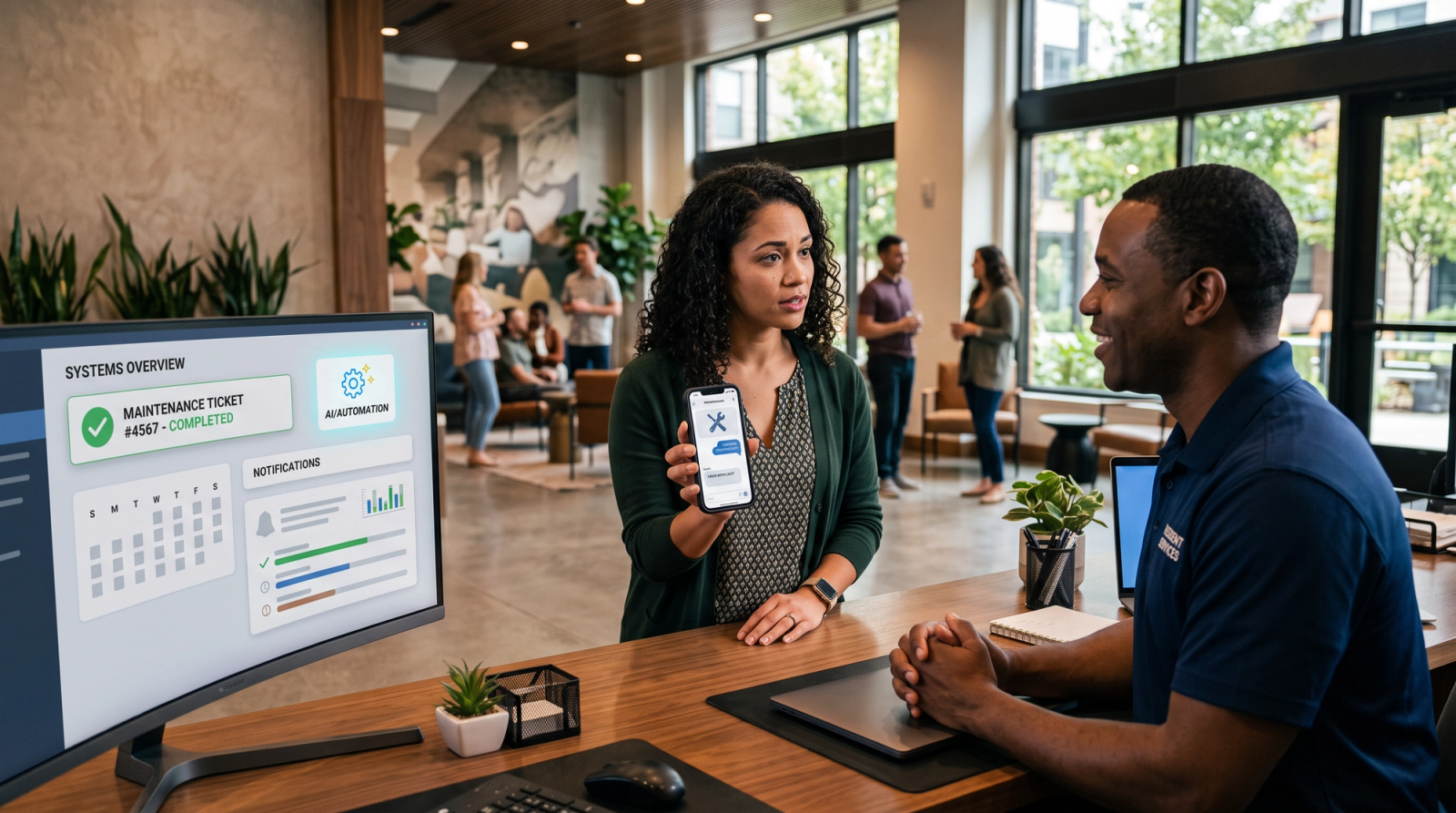
Automation is solving real problems in property management. Labor is expensive, onsite teams are stretched thin, and residents increasingly expect answers outside normal office hours.
That is why automation has become so attractive. It can reduce administrative work, speed up resident communication, streamline maintenance requests, and extend service beyond the leasing office’s schedule. The National Apartment Association’s coverage of Zego’s 2025 Property Management Operations Report found that most analyzed onsite tasks had reached some level of automation, including resident communication, lease renewals, maintenance requests, utility billing, and payment-related work.
That case is real. It is also incomplete.
A resident’s experience with a property is not made up entirely of transactions. When every interaction is forced through a portal, chatbot, automated text sequence, or workflow, an operator can make service more efficient while making the community feel less responsive, less personal, and less worth renewing with.
The question is not whether operators should automate resident-facing operations.
They should.
The question is where automation belongs—and where a person still needs to show up.
Some resident interactions should be automated.
A package locker is better than making someone wait for office hours to retrieve a delivery. Online rent payments are better than paper checks. Residents should be able to check a maintenance ticket, reserve an amenity, update insurance information, or receive a delivery notification without calling the leasing office and waiting for someone to answer.
Maintenance intake is another obvious use case. A system that captures photos, identifies an emergency, creates a work order, routes it to the right technician, and provides status updates is better than a voicemail sitting unheard until the following morning.
The efficiency gains are meaningful. The NAA’s summary of the Zego report found that manual hours for back-office operations fell from 67 per month in 2023 to 42 in 2024, while manual hours tied to resident operations fell from 89 to 53 per month. Those changes were associated with annual labor-cost reductions of roughly $9,600 for back-office tasks and more than $12,000 for resident operations.
Automation Saves Time and Money In these situations, the resident wants a fast and correct outcome. The interaction itself does not need to feel personal.
Automation works when it removes friction from routine tasks:
The resident benefits. The onsite team benefits. The property benefits.
The problem starts when operators assume every resident interaction belongs in that category.
A resident reporting a safety concern is not just submitting a ticket. Someone dealing with a difficult neighbor, repeated maintenance failures, a financial hardship, a possible accessibility issue, or a problem that does not fit neatly into a portal dropdown is not necessarily looking for an automated answer.
They want someone to listen.
An AI system can ask questions. It can recognize keywords. It can route an issue to the right team. It can escalate a conversation when a resident selects the right option or uses language the system recognizes as urgent.
But it cannot exercise judgment in the way a capable property manager can when a resident is trying to explain a complicated problem.
That distinction matters because the first interaction shapes how the resident feels about the property.
A resident who gets an automated confirmation after reporting a broken appliance may be satisfied if the repair is scheduled quickly and completed correctly. But a resident who has reported the same appliance three times, missed work waiting for technicians, and is now trying to explain why the issue has become intolerable is in a different situation.
The automated system may still see a maintenance request.
The resident sees a property that is not listening.
This is where the automation conversation becomes too focused on labor savings.
Most automation ROI models measure the same things:
Those are useful metrics. They tell an operator whether the technology is improving workflow efficiency.
They do not necessarily tell an operator whether residents feel more connected to the property, more confident that someone will help when something goes wrong, or more likely to renew.
That is the retention risk hiding behind a seemingly successful automation rollout.
A property can improve response time, reduce payroll pressure, and close more routine requests without improving the resident experience in the way that matters at renewal. In some cases, it may make the resident experience worse. Not dramatically worse.
Not always enough to create a public complaint or a one-star review.
Just worse enough that, when renewal time arrives, the resident feels little reason to stay.
If a comparable community down the street offers a similar apartment for slightly less rent, a resident who feels no relationship with the current property has less reason to absorb an increase or overlook a minor inconvenience.
This is why retention cannot be treated as a separate initiative from operations. MRI’s multifamily retention guidance identifies communication access, maintenance performance, resident feedback, personalized service, and community engagement as components of resident satisfaction and long-term tenancy. The important point is not that every resident wants a high-touch interaction. Most do not. It is that residents need a reliable human path when the automated path stops being enough.
The industry has plenty of evidence that automation can reduce routine workload. It has far less evidence about what happens to the resident relationship when automated systems become the primary point of contact.
That gap should concern operators.
A resident may be satisfied with a package locker, online payments, digital leasing documents, and automated work-order updates. Those are all improvements when they work well. But satisfaction with a transaction is not the same as confidence in the property.
Operators need to know what happens when residents have concerns that are emotional, ambiguous, urgent, repetitive, or difficult to explain. They need to know whether residents can reach a person without fighting through a phone tree, chatbot, portal workflow, or generic inbox.
They also need to connect automation reporting to retention reporting. Don’t judge a rollout only by whether it saves staff time. Evaluate it against a broader set of measures.
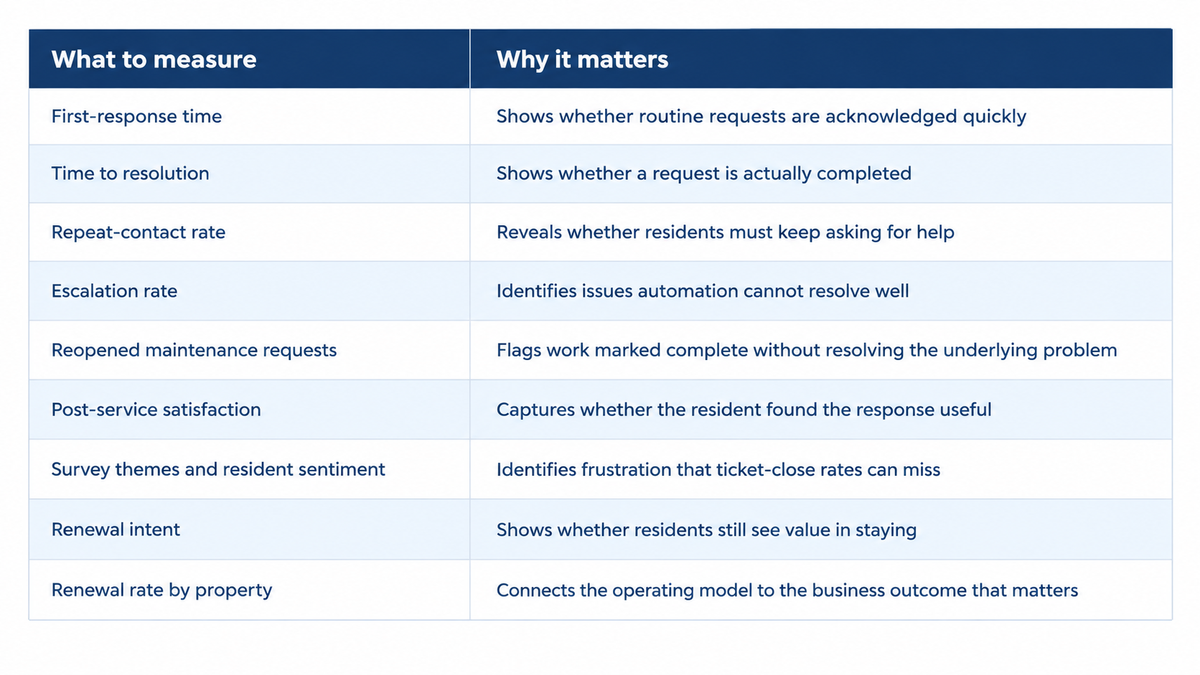
MRI recommends regular resident surveys, multiple communication channels, and ongoing feedback collection precisely because operational teams need a way to understand needs that do not show up in a standard transaction log.
How to Increase Multifamily Tenant Retention
A ticket that closes quickly is not necessarily a problem that has been solved well.
The better approach is not to avoid resident-facing automation. It is to use it with a clear boundary.
Automate high-volume, predictable work that residents want to complete quickly:
Then make it easy to reach a person when the interaction needs judgment, empathy, authority, or context.
That means residents should not have to use the “correct” phrase to escape a chatbot. They should not have to repeat the same issue after an automated handoff. And they should not be pushed back into a portal when the issue is clearly more complicated than a standard workflow can handle.
A good escalation process does three things:
This is the strategic opportunity behind automation. The National Apartment Association’s reporting makes the operational case plainly: technology can reduce the time and money spent on administrative work, allowing teams to focus their attention elsewhere, including resident and staff retention.
Automation Saves Time and Money
The key is deciding where that recovered staff capacity goes.
If automation saves 20 or 30 staff hours per week, the most straightforward financial argument is to remove 20 or 30 hours of labor.
The technology appears to pay for itself faster. The property gets an immediate expense reduction. The operating margin improves.
But that is not always the best use of the gain.
A stronger approach is to reinvest some of the recovered capacity into work that tends to disappear when onsite teams are overloaded:
This work does not produce the same clean, immediate number as a reduction in payroll. It is harder to place into a vendor ROI calculator.
But it is often the work that determines whether residents see the property as a community that responds to them—or as a system they have to navigate.
The question is not whether an automated system can answer a resident faster than a person can.
Often, it can.
The question is whether the system improves the resident experience in the moments residents are most likely to remember.
Operators should not confuse fewer calls with fewer problems. They should not assume a fast automated response creates trust. And they should not measure an automation rollout only by labor savings if the investment can influence renewal decisions months later.
The strongest resident-facing model is not fully staffed or fully automated.
It is a model where technology handles routine work well enough that staff have time to handle the human work well.
Automate the transaction. Keep people available for the relationship.
Before renewing property software, test what you can retrieve. Downloadable reports do not establish that your records are complete, usable, or ready for another system.
The financing will support broader housing automation as EliseAI’s Apollo assistant moves beyond conversations to completing tasks across property operations.
Four platforms have moved past the pilot stage and into daily leasing and maintenance work. Here's what each one actually does, and the questions worth asking before signing a contract.