Boston Announces More Than $16 Million for Fairmount Housing Upgrades
Planned work at the public housing community pairs heating and hot water electrification with cooling, accessibility upgrades and stormwater improvements.


OperationsSector Playbook
Water waste rarely begins as a utility issue. It starts with a slow leak, an unclear escalation path or a repair request that never reaches the right person.
So what: Operators can reduce avoidable water expense and damage by treating abnormal consumption as an operations signal, not a monthly accounting surprise.
A water bill is often reviewed after the cost has already been incurred.
By the time a utility invoice shows a major increase, a leaking toilet may have run for weeks, an irrigation valve may have failed overnight, a hot-water circulation issue may have gone unnoticed or a small supply-line leak may already have created a larger repair and resident-service problem.
That is why water expense should not be treated only as a utility-management issue. It is an operations issue, a maintenance issue and, in some cases, a resident-experience and risk-management issue.
The U.S. Environmental Protection Agency says leak-detection and flow-monitoring devices can identify leaks and irregular water-use patterns, helping reduce wasted water and damage. Although its consumer guidance focuses on homes, the EPA notes that the same technologies can be used in multifamily, commercial and institutional buildings.
For property managers, the practical question is not simply whether to install another device. It is whether the organization can detect abnormal use, assign ownership, reach the right person and resolve the underlying issue before it becomes an expense, a repair or a resident complaint.
In many apartment organizations, water has no clear operational owner.
Accounting receives the bill. Maintenance responds when a resident submits a request. Grounds teams may handle irrigation. A utility-billing vendor manages resident charges. A regional manager reviews budget variances. Insurance becomes involved only after a larger event.
Each function sees part of the issue. No one necessarily sees the full pattern.
That creates a predictable delay:
The better model is to treat water-use anomalies as operational alerts.
A sudden increase in overnight use, sustained continuous flow, an unusual jump in one building’s consumption or a sharp change after irrigation should prompt an investigation before the monthly invoice arrives.
ENERGY STAR recommends benchmarking as a first step in managing multifamily utility performance. Its Portfolio Manager tool is used to track water use, and multifamily properties with 20 or more units may be eligible for a 1 to 100 Water Score that compares indoor and outdoor water performance with similar properties nationwide.
Benchmarking will not identify every leak. It can, however, help owners and operators distinguish normal seasonal or occupancy-related changes from patterns that deserve attention.
Not every water issue is dramatic. The most expensive waste can come from problems that appear minor.
A toilet that continues running after flushing may not trigger a resident complaint, especially if the sound is subtle or intermittent. But continuous flow can accumulate quickly and may continue until a resident notices it, a routine inspection occurs or the bill reveals the problem.
Irrigation systems can waste water through broken sprinkler heads, damaged mainlines, poorly calibrated schedules, failed rain sensors or zones that continue running after a controller problem.
A visual inspection should look for broken or clogged heads, pooling water, runoff and zones operating when they should not. A pattern of abnormal water use after irrigation changes may indicate a programming or equipment problem, not a general increase in demand.
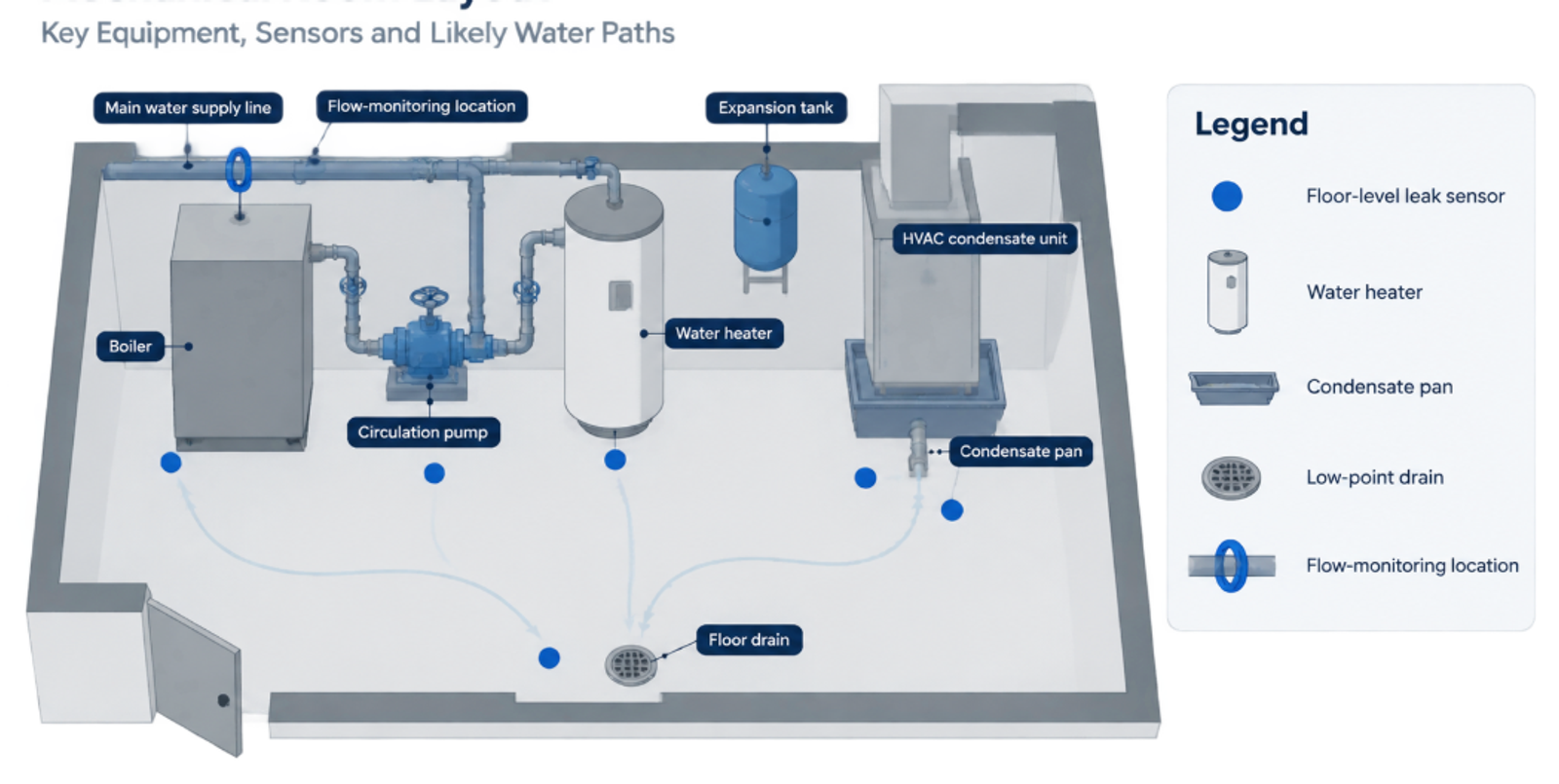
Hot-water circulation systems, boilers, pumps and mechanical-room components can create water loss that residents may never see. These failures often require a different detection method than a unit-level sensor, such as supply-line monitoring, pressure testing or review of unusual overnight flow patterns.
A small leak beneath a sink, behind a refrigerator, near a water heater or beside a washing machine may begin as a maintenance issue. If it goes undetected, it can become a flooring, drywall, mold, insurance and resident-relocation issue.
Pools, fountains, dog-wash stations, laundry rooms, common-area restrooms and package rooms with utility connections can all create water-loss risk. These spaces may receive less frequent attention than apartments, even though a small failure can run for days before it is noticed.
Water-monitoring technology can improve visibility. But an alert is not the same as prevention.
A sensor that sends a notification at 2 a.m. only helps if someone receives the alert, understands the urgency, has authority to act and can reach the property, resident or emergency vendor.
The EPA describes two core methods used by leak-detection systems: moisture detection, which alerts users to unexpected dampness, and flow monitoring, which measures water flow and can identify usage patterns associated with leaks or irregular consumption. EPA WaterSense
For multifamily operators, technology selection should start with the operating problem:
The key question is not, “What device should we buy?”
It is, “What will our team do when the device tells us something is wrong?”
Every property should have a documented water-alert workflow. The details will vary by property type, staffing coverage and system design, but the structure should be clear.
Not every alert has the same urgency.
A point sensor detecting water beneath a kitchen sink may require immediate contact and access coordination. A moderate but sustained increase in building flow may require review during business hours. A sudden spike combined with a pressure drop may require emergency response.
The goal is to avoid treating every alert as either an emergency or an item for next week’s maintenance meeting.
At minimum, the workflow should identify:
Without defined ownership, alerts become another inbox problem.
When an alert affects an occupied apartment, the resident should receive clear, practical information.
A useful message can explain that the property detected a possible water issue, needs to inspect the area and will provide a time window or next update. It should not assume the resident caused the problem.
This matters because residents may be wary of unexpected access requests, particularly if they are not experiencing an obvious issue.
A repair is not complete because an alert has been acknowledged.
The team should document:
That last question is essential. A single failed supply line may be isolated. Three similar failures across one building may indicate aging components, a vendor-quality problem or a need to revise replacement planning.
Water management does not require a perfect data environment. It does require enough visibility to identify where the property is losing control.
A practical weekly or monthly review can include:
The objective is not to turn onsite teams into utility analysts. It is to give operations leaders enough information to ask the right questions early.
For example:
Water loss can become a resident-experience problem long before it becomes a large insurance claim.
A resident may be affected by a leaking ceiling, shutoff for an emergency repair, noisy remediation work, reduced access to a kitchen or bathroom, or repeated entry requests from vendors.
The property’s response shapes how the resident experiences the incident.
The same principles that apply to maintenance service also apply here:
Water monitoring and leak detection can help prevent damage. But they do not eliminate the need for communication when a problem occurs.
Operators can begin improving water management without committing immediately to a portfolio-wide technology rollout.
Gather the last 12 months of water and sewer bills. Compare cost and consumption by property, building and month where data is available.
Then identify:
For each property, document what happens when a resident reports a leak, a meter indicates abnormal usage or a sensor sends an alert.
Test the process with a simple question:
At 2 a.m. on a Saturday, who receives the alert, who decides whether it is urgent, who can access the affected area and who can shut off the water?
If the answer depends on someone improvising, the property does not yet have a complete response plan.
Use the baseline and workflow review to choose the first interventions.
Those may include:
The best first investment is not always the most advanced technology. It is the improvement that closes the largest gap between detection and response.
Water loss often appears in financials as a utility variance. But the underlying cause is usually operational: a leak no one detected, an alert no one owned, an irrigation system no one reviewed or a repair process that did not move quickly enough.
That makes water management a shared responsibility across maintenance, onsite operations, vendors, finance and resident services.
The operators that treat water as a monthly bill will keep reacting to surprises.
The operators that treat abnormal water use as an operating signal can reduce waste, limit damage and protect both NOI and resident trust.
Planned work at the public housing community pairs heating and hot water electrification with cooling, accessibility upgrades and stormwater improvements.
A closed ticket does not prove a lasting repair. Auditing repeat requests helps operators distinguish unresolved problems, recurring failures, and planned follow-ups.
A completed work order does not authorize move-in. A clear handoff between maintenance, management, and leasing makes unit readiness a documented decision.