
Rental Fee Rules Reset in 2027 as Illinois and Seattle Join Colorado
Illinois and Seattle have set 2027 start dates for rental fee limits and upfront disclosure, and Colorado’s rules already apply. Fee schedules now need a compliance owner.


Policy & ComplianceAnalysis
HUD’s 2026 shift separates trained service animals, ESAs, and pets—but state and local ESA protections may still apply.
So what: Leasing teams need to distinguish trained service animals from ESA requests, which now require a state- and local-law review. Use a clear intake process, counsel-approved script, and escalation path for any unclear or contested request.

Updated September 2026 to reflect HUD's May 22, 2026 enforcement memo. This is an operations explainer, not legal advice. State and local law can require more than HUD currently enforces, so confirm your jurisdiction's rules with counsel.
Leasing offices mix up these three categories constantly, and the confusion is more than a paperwork nuisance. Each category carries its own legal standard. Apply the wrong one and you either expose the property to a fair housing complaint or hand a resident an easy way around the pet policy.
The rules also just moved. For about a decade, HUD guidance grouped service animals and emotional support animals under one umbrella, "assistance animals," and the main difference between them was what documentation a housing provider could ask for. That guidance is gone, and HUD hasn't replaced it with a new playbook.
A service animal is individually trained to do work or perform a task directly tied to a person's disability. Guiding someone who is blind, alerting someone who is deaf to a sound, helping during a seizure, and assisting someone with a psychiatric disability all qualify. HUD's new memo didn't narrow this category. It made trained animals the only category HUD will actively back: a request to waive pet policy for a trained animal is "presumptively reasonable" under the May 2026 memo.
One detail leasing staff get wrong: in housing, a trained animal doesn't have to be a dog. The ADA limits service animals to dogs in public spaces, and your leasing office counts as one. But HUD's memo says an accommodation under the Fair Housing Act "could involve a species other than a dog," provided the animal is trained to perform a disability-related service.
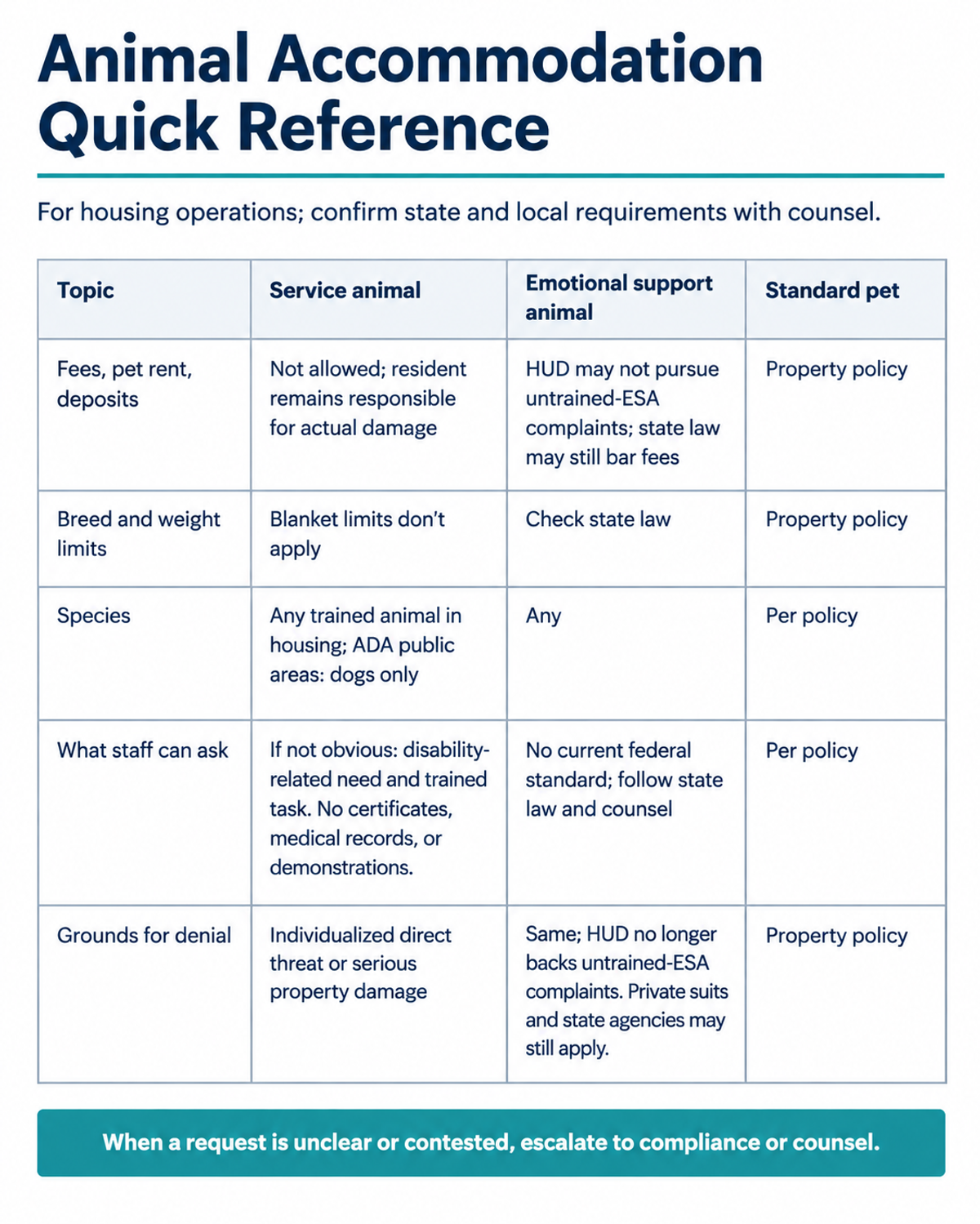
Operators can't charge pet rent, pet fees, or pet deposits for a service animal, and blanket breed or weight limits don't apply. The resident is still responsible for actual damage the animal causes, the same as any other damage to the unit.
There is no official certification or registry for service animals, so asking for a certificate gets you nothing. When the disability or the animal's job isn't obvious, the ADA rules that govern public areas like a leasing office allow exactly two questions: is the animal required because of a disability, and what work or task has it been trained to perform. Staff can't ask about the disability itself, require medical or training documentation, or ask the animal to demonstrate, according to the Justice Department's service animal guidance.
Inside the unit, the answer is less settled. HUD's memo calls the ADA rules "instructive" but never says whether housing providers are held to those two questions, a gap that attorneys at Seyfarth Shaw flag as one of the memo's biggest unanswered issues. Because the federal standard now turns entirely on training, expect that second question to carry a lot more weight at the desk. Have counsel approve the exact script your staff uses.
The one real limit is the direct threat standard, and it's narrower than most leasing staff assume. An operator can deny or remove an animal that poses a genuine, documented threat to health or safety, or that would cause serious damage to property (a bite history, an aggression incident, damage that training or containment can't prevent). That has to be an individualized finding about this specific animal. A breed assumption doesn't qualify, and neither does a hunch.
This is the category that actually changed, and it's where most of the outdated advice floating around leasing offices will cause problems.
From 2013 until September 2025, HUD's guidance (FHEO Notice 2013-01 and FHEO-2020-01) treated ESAs almost like service animals for accommodation purposes: no pet fees, no breed restrictions, and a documentation standard HUD itself defined. Landlords who wanted to push back on a claimed ESA had a fairly clear process to follow.
HUD withdrew both notices on September 17, 2025, and published that withdrawal in the Federal Register on April 6, 2026. Then on May 22, 2026, FHEO Assistant Secretary Craig Trainor signed an enforcement memo that permanently rescinded the 2020 notice. It told HUD staff to find reasonable cause "only for those cases involving animals trained to provide disability-related assistance." Emotional support, comfort, and companionship don't count as a task under that standard, and requests to waive a pet policy for an untrained ESA are no longer presumptively reasonable. Open ESA cases were sent up to headquarters for case-by-case review.
The old documentation framework went with the notices, and the memo doesn't replace it. No current federal standard tells operators what proof they can or can't request for an ESA claim.
ESA obligations didn't vanish, though. They moved out of HUD's hands. The Fair Housing Act itself wasn't amended, and the memo states plainly that it doesn't affect a resident's right to sue; the Act gives residents two years to file. Courts aren't bound by an enforcement memo either, since it isn't a regulation, as Seyfarth Shaw points out.
States are also pushing back. In July 2026, California's Civil Rights Department issued a legal alert saying HUD's guidance "has no impact" on the complaints it will accept, and that California law still requires accommodating ESAs whether or not they're trained, including waivers of pet fees and breed restrictions. Illinois and New York City have their own ESA frameworks as well. HUD routinely refers complaints to state and local agencies, and nobody knows yet whether those agencies will follow HUD's new approach.
So the real change is in the odds of HUD stepping in on a resident's behalf. Those odds dropped sharply. Treating that as ESAs losing legal protection outright creates its own liability, especially for portfolios in states like California.
The old advice about online certificates holds up. A paid "ESA registration" or certificate never carried legal weight, and it never depended on the notices HUD withdrew. HUD's own memo cites a dismissed complaint involving three ESAs backed by an online form letter as an example of the kind of case it no longer wants to pursue.
For leasing staff, stop treating every ESA claim as automatically bulletproof, and don't swing to treating them as automatically ignorable. Route anything borderline to legal or compliance instead of making the call at the desk.
A pet with no disability-related claim falls under whatever policy the property has on the books: fees, breed and weight limits, registration paperwork. Fair housing protections don't apply, so this is the one category where the operator has full control.
Some of it is staff applying pet fees and breed limits to a legitimate service animal. That was a violation before the guidance change and it still is. Nothing here gives cover for it.
The other direction is trickier now. The old risk was not scrutinizing ESA claims closely enough and letting residents use them to sidestep the pet policy. That risk is still around, and a newer one has shown up next to it: staff who haven't caught up on the HUD change may assume an ESA claim carries the same ironclad protection as a service animal, when the federal backing behind that assumption is much weaker than it was a year ago.
Both mistakes cost money. One brings fair housing exposure. The other means lost pet fee revenue and a breed policy nobody enforces. Make sure staff know which version of the rules is in effect, federal and state, before they apply either one.
If a request is ambiguous, the safer default is still to treat it as legitimate and escalate it for review rather than deny it at the desk. A short delay costs less than a wrongful denial.
Illinois and Seattle have set 2027 start dates for rental fee limits and upfront disclosure, and Colorado’s rules already apply. Fee schedules now need a compliance owner.
HUD will move Emergency Housing Voucher families leased as of Sept. 30 onto Tenant Protection Vouchers by year end. PHAs have until Oct. 15 to correct HUD’s award estimates.
California lawmakers have sent AB 2050 to Gov. Gavin Newsom, requiring financially underfunded associations to strengthen 30-year reserve planning beginning in 2032.