Rental Fraud Starts Before Move-In: A Verification Playbook for Leasing Teams
Fraud prevention cannot sit entirely with screening software. Leasing teams need consistent verification and escalation procedures before keys change hands.


RiskAnalysis
Landscaping, maintenance and capital projects affect wildfire exposure. Property managers need to understand those connections and document the work.
So what: For wildfire-exposed properties, mitigation belongs in vendor scopes, work orders and owner budgets. Documentation also matters when discussing completed improvements with insurers.
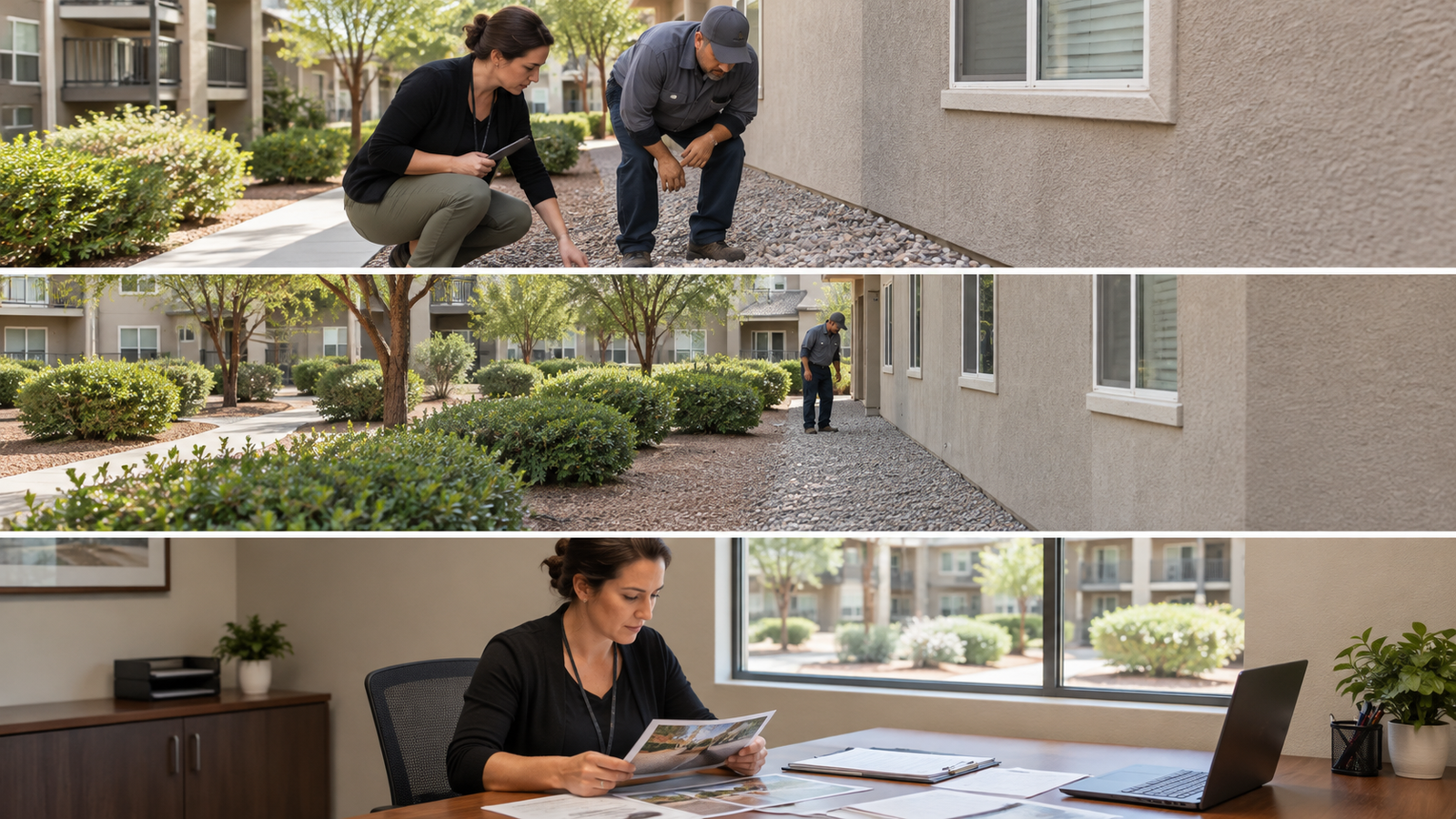
A landscaping contractor proposes fresh bark mulch beside an apartment building. A maintenance technician finds leaves beneath a deck. An owner considers replacing aging windows.
Those decisions move through different budgets and vendors. At a wildfire-exposed property, they also belong in the same risk-management conversation.
CAL FIRE’s defensible-space guidance addresses combustible mulch, accumulated debris and vegetation near structures. California’s insurance regulator identifies roofs, vents, windows and other building features as part of its wildfire-mitigation framework. Together, those sources show how routine property decisions connect to fire exposure.
For managers, the assignment is not to become fire-protection engineers. It is to recognize which conditions need attention, know when to involve qualified specialists and keep a reliable record of what happens next.
The distinction matters. Recognizing a problem, securing owner approval and verifying completed work are separate responsibilities. A property’s operating process needs to connect them.
Defensible space is the buffer between a structure and its surroundings. Managing vegetation and combustible materials within that area can help slow fire spread and reduce exposure to embers, flames and heat.
That makes a landscaping proposal more than an appearance-and-cost decision. The materials placed beside buildings, the location of shrubs and the removal of dead vegetation also deserve review.
CAL FIRE identifies the first five feet around a structure as especially important. Its guidance recommends hardscape such as gravel, pavers or concrete instead of combustible bark or mulch. It also calls for removing dead vegetation and debris from roofs, gutters, decks, porches, stairways and areas beneath the home.
For a management team, the practical step is to translate applicable requirements and site-specific guidance into a defined scope of work.
“Maintain landscaping” does not establish who checks beneath decks, who removes accumulated debris or who reports a condition beyond the contractor’s assignment. A useful scope identifies the areas to maintain, the work to perform, the conditions to escalate and how completion will be confirmed.
California’s guidance is not a nationwide compliance checklist. CAL FIRE advises property owners to check with their local fire department or fire protection district, noting that some local standards are stricter than state minimums. Managers should establish what applies to the property before treating a general recommendation as a legal requirement.
Clearing debris and replacing exterior building components should not travel through the same approval process.
One is recurring maintenance. The other may require technical assessment, specifications, permits and capital funding, depending on the project and jurisdiction.
California’s Safer from Wildfires framework illustrates the range of work involved. Its measures include clearing vegetation beneath decks, establishing an ember-resistant area around structures, using Class A fire-rated roofs, installing ember- and fire-resistant vents, enclosing eaves and upgrading windows.
Managers can organize recommendations into three working categories:
That structure gives owners something more useful than a broad request to “improve fire safety.” It identifies the observed condition, the recommended next step and the decision needed.
Scheduled replacement projects also create an opportunity to ask better questions. If a roof or window project is already in the budget, the project team should assess whether its specifications address wildfire exposure. California’s insurance department specifically identifies roof and window replacement as opportunities to improve a property’s wildfire resistance.
The manager’s role is to bring the question into the project, not to select technical solutions without appropriate expertise.
Completing mitigation work does not automatically put the information in front of an insurer.
In its September 2026 Safer from Wildfires FAQ, the California Department of Insurance says its regulation requires mitigation discounts for residential and commercial policyholders under the framework. Discount amounts depend in part on the property’s characteristics, the actions completed and the insurer.
The department advises policyholders to contact their insurer or agent/broker after completing a mitigation action. Proof may be necessary, or an inspection may be required to confirm completion. The FAQ says resulting premium savings would be reflected at the start of the next policy period.
That creates an important handoff between property operations and insurance administration. Closing a maintenance ticket is not the same as notifying the broker or providing the evidence an insurer requests.
Before commissioning a substantial project, managers should ask the insurance representative what documentation will be needed and how any applicable discount will be evaluated. The answer should inform recordkeeping, not replace the technical assessment of the work.
California provides a specific example of mitigation-linked insurance pricing. Managers elsewhere should verify their own insurer’s practices and applicable rules. A completed improvement should not be presented as a guarantee of coverage, renewal or a particular premium reduction.
A useful mitigation file should make the status of each item clear.
The record can include:
This is a recommended operating structure, not a universal insurer submission standard. California’s guidance establishes that proof or an inspection may be required; the insurer or broker should explain what evidence is acceptable for the particular policy.
The file should also preserve distinctions that can disappear during a busy operating cycle. A proposal is not a completed improvement. An approved budget does not establish that installation occurred. A paid invoice does not necessarily answer every question about the materials used or the work performed.
If an owner defers a recommendation, keep the item visible, along with the decision and any agreed follow-up. It should not disappear because the original inspection is closed.
Some mitigation work takes place in areas residents use every day.
CAL FIRE’s guidance addresses combustible outdoor furniture and planters on decks, firewood placement, and other materials close to structures. At a rental community, addressing those conditions may require communication and coordination with residents as well as work by maintenance staff.
A notice should explain the affected area, the action requested, the deadline and whom to contact with questions. “Be fire safe” is not an operating instruction.
Before adopting new restrictions or enforcement procedures, management should review applicable lease terms and legal requirements and obtain qualified advice where needed. Site-specific fire guidance should inform the communication rather than be turned into an unsupported blanket rule.
Resident notices also should not substitute for management’s own work. Asking residents to keep an area clear does not resolve a separate debris-removal assignment or building repair.
Defensible-space maintenance is recurring work. CAL FIRE calls for regular tree trimming and repeated removal of dead vegetation, leaves and needles. A one-time cleanup therefore does not settle the ongoing assignment.
A workable process connects inspection, responsibility, funding and follow-through:
The key is verification. Someone needs to establish that the requested work was completed, identify anything still outstanding and preserve the record.
For wildfire-exposed properties, mitigation becomes an operating responsibility through these handoffs. The landscaping contractor needs a clear scope. The maintenance team needs an assignment. The owner needs a decision request. The insurance representative needs the evidence required for the policy.
A work order marked complete is an administrative status. The management task is to know what was done, whether it was checked and where the supporting record can be found.
Fraud prevention cannot sit entirely with screening software. Leasing teams need consistent verification and escalation procedures before keys change hands.
Better insurance terms increasingly go to apartment owners that can document building condition, loss prevention, and completed risk-reduction work.