The Best Apartment Amenity Might Be Something You Don’t Have to Own
At some apartment buildings, residents can borrow household items when they need them, then give the space back to their homes.


Resident ExperienceAnalysis
Golf simulators and putting greens can distinguish multifamily properties. Their lasting value depends on resident use, operating costs and the space they occupy.
So what: Tour appeal is not an investment case. Owners should weigh golf against other uses of space and track repeat participation, costs and reliability.
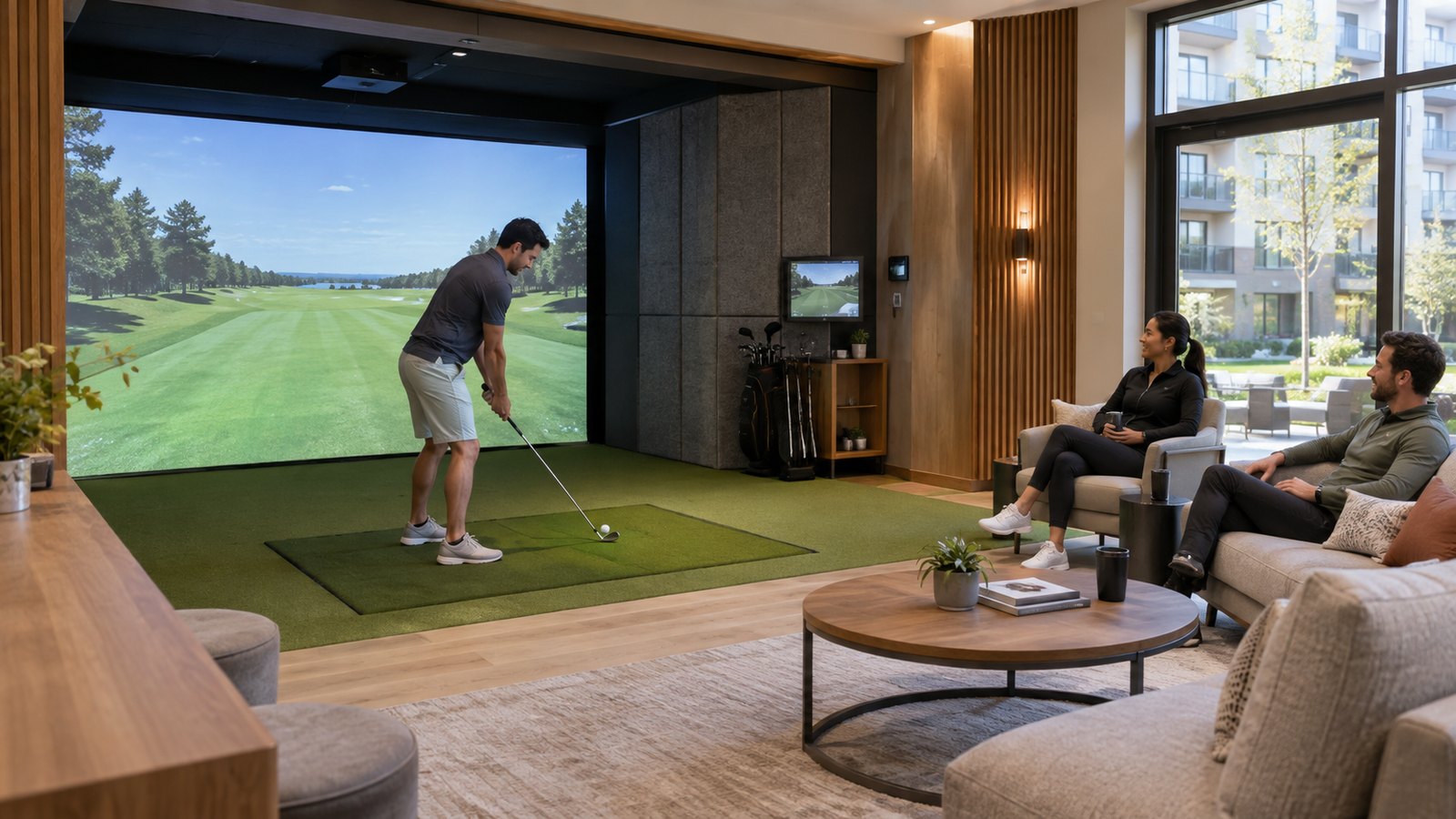
Golf simulators and putting greens can distinguish a property. Their lasting value depends on resident participation, operating costs and the space they occupy.
A virtual fairway can be an appealing stop on an apartment tour. For prospective residents who enjoy golf, an indoor simulator offers an easy-to-understand proposition: a place to play without leaving home. For the property operator, the more consequential question comes after move-in. Does that initial appeal become a reason residents value living there?
Golf is no longer confined to residential communities built around a course. At Apex41 in Lombard, Illinois, amenities include an indoor golf simulator, while property manager RMK confirms an outdoor putting green. The Arcadian, a 502-unit apartment community in Fort Lauderdale, lists two golf simulators alongside indoor pickleball, a sauna and coworking spaces. These properties bring golf into a broader recreation package without making it the organizing principle of the community.berkadia+3
Their presence establishes golf as an option in multifamily amenity design. It does not establish its return. The cited property materials describe the facilities but do not provide utilization figures or evidence that golf increases rents or improves retention.liveapex41+1
That distinction matters. An amenity can help a property stand out during leasing while contributing relatively little to everyday resident life. Golf’s investment case rests on whether it can do both.
The growth of off-course golf gives operators a credible reason to consider the amenity. The National Golf Foundation’s participation figures show that 48.1 million Americans participated in on-course or off-course golf in 2025. Of those, 19 million participated exclusively off-course, a category that includes driving ranges, simulators and golf entertainment venues.ngf
The simulator audience also reaches beyond traditional course golfers. In its April 2025 simulator white paper, the foundation reported that 51% of simulator users had not played on a golf course during the preceding 12 months. It counted 8.1 million simulator and screen-golf participants in 2024, compared with 3.8 million in 2015.indoorgolfalliance
Those figures challenge the idea that a residential golf room must cater only to experienced players. A simulator can be positioned as a practice space, but it can also be approached as casual recreation.
For a property owner, those are different propositions. A dedicated golfer may want uninterrupted practice and detailed swing feedback. A beginner may need a simple introduction before feeling comfortable booking a session. Residents looking for a shared activity may care more about seating and approachable games than technical capabilities.
The equipment alone does not resolve those differences. A property needs a clear idea of whom the room is intended to serve—and how that audience will use it.
National participation figures support considering golf. They cannot establish demand at a particular building.
The investment decision is not simply whether a simulator would be attractive. It is whether golf represents a better use of the available space than another amenity.
At City Walk at Woodbury, a 453-unit community in Minnesota, an indoor golf simulator accompanies an indoor pool, sauna and other shared amenities. At The Arcadian, golf is likewise one component of a larger recreation and lifestyle offering.rejournals+2
In that context, golf does not have to serve every household to justify its place. A well-balanced amenity package can accommodate different interests. But a specialized room still consumes capital, space and management attention.
The case is stronger when golf addresses an identifiable interest among the property’s intended residents. It is weaker when the principal justification is that competing developments have added a simulator.
This is where a property-level assessment becomes more useful than a trend report. Resident surveys, prospect feedback and a review of existing amenity use can help distinguish a genuine gap from enthusiasm for something new. The important question is not simply whether people like the idea of golf, but whether they expect to participate regularly.
A feature that attracts attention is doing one job. A space that becomes part of residents’ routines is doing another.
A simulator may look like a self-contained purchase, but the resident experience depends on the room and operating model around it.
Before installation, the property has to establish whether the proposed space is suitable. Swing clearance, equipment placement, accessibility and the relationship to neighboring uses require attention. Manufacturer specifications and qualified design review should guide that assessment rather than the assumption that an unused room will work.
The financial evaluation should extend beyond the initial hardware. Room preparation, installation, software, support and eventual replacement all belong in the investment case.
After opening, the responsibility shifts from development to operations. Residents need to understand how to use the system, how to reserve it and what to do when something goes wrong. Management needs clear responsibility for maintenance, troubleshooting and damage.
Access rules deserve particular attention. A small group of enthusiastic users can keep a simulator busy without making it broadly available. Conversely, restrictive booking rules can make a desirable amenity feel inconvenient.
Neither outcome is visible in a leasing brochure. Both can influence how residents judge the facility once they live with it.
Programming is one way to test whether the room can reach beyond established golfers. Introductory sessions, casual competitions or occasional instruction could provide an entry point for residents who would not book it independently. Those activities should be treated as experiments in participation, not assumed benefits.
The goal is not to fill an events calendar. It is to find out whether the amenity can develop a durable audience.
The most useful measures are straightforward: how many households participate, how often they return, whether desirable booking times remain accessible and what it costs to keep the facility operating.
Total reservations alone are insufficient. Repeat bookings by a few residents indicate strong interest within that group, while a high number of first-time users followed by little return activity may suggest novelty rather than sustained value.
Prospect feedback belongs in the assessment, but it requires similar care. A prospective resident may praise the simulator and still choose the property primarily for location, price or unit quality. An appealing tour stop is not proof that the amenity caused a lease.
The same caution applies to commercial simulator economics. NGF’s simulator white paper is directed at golf-facility operators assessing business opportunities; it is not a residential return-on-investment study. Its conclusions should not be treated as evidence of what an apartment owner will earn from offering resident access.ngf
For multifamily, the stronger case is grounded in the property’s own experience. Does golf reach the intended audience? Does participation persist? Is the service reliable? Do residents consider it a meaningful part of living there?
Golf’s growing audience makes it a credible amenity candidate. Its lasting value depends on a less photogenic result: residents continuing to use it long after the leasing tour.
At some apartment buildings, residents can borrow household items when they need them, then give the space back to their homes.
At Denizen Bushwick and Haus25, hydroponic farms offer city renters more than a view of greenery: an opportunity to grow produce or take home a harvest.
A four-property preservation project modernized 341 public-housing apartments in Troy, adding energy upgrades, accessibility improvements, and resident return protections.