Seattle Apartment Vacancy Falls as New Deliveries Slow
Seattle apartment vacancy fell to 6.6% in the third quarter as occupied-unit growth outpaced completions. Asking rents rose annually but slipped from the second quarter.


Leasing & RevenueAnalysis
Residents remember slow repairs at renewal time. Property managers need to measure maintenance service as a retention and revenue function, not just a closed-ticket count.
So what: Maintenance is one of the few resident-experience levers operators directly control. Faster updates, durable repairs and clearer ownership can help protect renewals and reduce costly turnover.
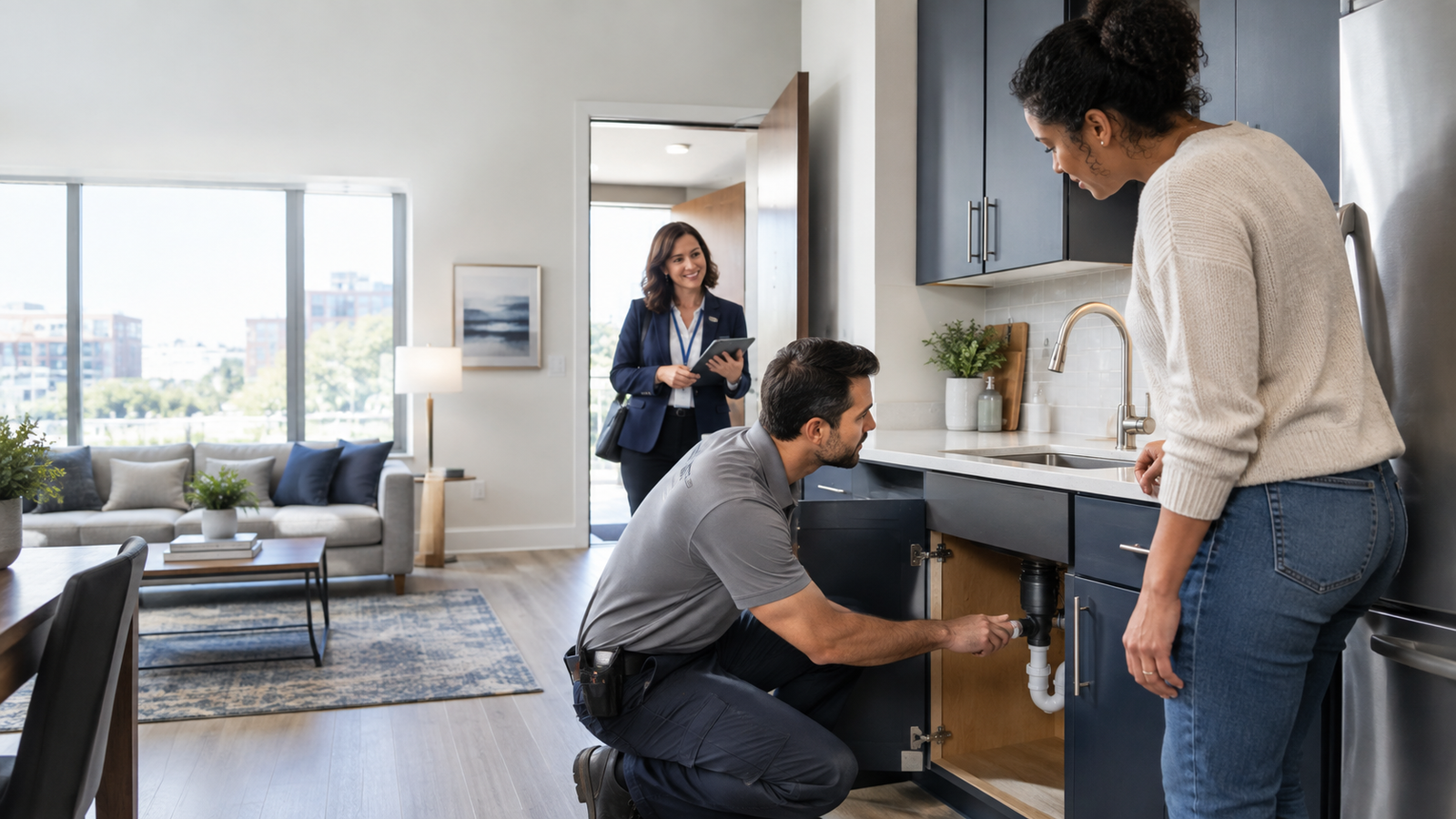
Poor maintenance response is not only a service issue. It is a resident-retention issue.
For years, property-management companies have treated maintenance performance as an operational scorecard: How many work orders are open? How quickly are they closed? Is the maintenance team staying within budget?
Those measures matter. But they do not answer the question residents are actually asking:
When something in my home breaks, can I trust my property manager to take it seriously and keep me informed?
That answer can shape whether a resident renews, recommends the community or starts looking for a new apartment.
AppFolio’s 2026 Renter Preferences Report, based on a survey of 3,002 U.S. renters, identifies maintenance as the strongest driver of overall resident satisfaction. Among residents satisfied with maintenance, 56% said they planned to renew or stay, compared with 31% of residents dissatisfied with maintenance. The report also found that 79% of satisfied residents said maintenance issues were resolved within a few days or less, while 53% of dissatisfied residents said they waited weeks or longer.
The operating implication is straightforward: maintenance should be managed as a retention system, not merely a work-order system.
Residents do not experience maintenance through a dashboard.
They experience a dripping ceiling at 10 p.m., an air conditioner that is not cooling, a dishwasher that stops working or a repair appointment that requires them to rearrange a workday. They experience whether a request is acknowledged, whether someone explains the next step and whether the issue is actually fixed the first time.
A property-management system may show that a work order was completed in 48 hours. The resident may remember that nobody contacted them for 36 hours, they followed up twice and they lost another afternoon waiting for a vendor who did not arrive.
Those are two very different outcomes.
The National Apartment Association reports that renters identify expensive rent, poor maintenance response and security concerns as their three leading reasons for not renewing. When renters rank the components of the apartment-living experience, maintenance and repairs come first, ahead of security and community appearance.
Maintenance will not solve every renewal decision. Rent, location, life changes and household needs will always affect whether residents stay.
But maintenance is one of the clearest places where a property team can earn trust or lose it.
Average work-order closure time is one of the industry’s most common maintenance metrics. It can be useful. A community with long closure times, a growing backlog or an unusually high emergency volume likely has a real service issue.
But closure time alone can conceal the experience that drove the resident’s frustration.
A work order may close quickly because:
Conversely, a complex repair may take several days for legitimate reasons. A part may need to be ordered, a specialized vendor may be required or the team may need resident access before work can begin.
The central issue is not speed alone. It is whether the resident feels informed, respected and confident that the issue has a clear owner.
Zego’s 2026 Resident Experience Management Report found that 60% of renters expect maintenance issues resolved within two days, while 11% expect same-day resolution. Only 7% of surveyed property managers said they aim for same-day resolution. Nearly half said a one- to two-day resolution timeline was typical, while 44% said three to five days was normal.
The report also found that 89% of renters consider maintenance status updates important or extremely important.
Operators do not need to promise that every repair will be completed immediately. They do need a service standard that distinguishes urgency, acknowledgment, communication and resolution.
Residents typically judge maintenance service at four points.
The first question is simple: Did anyone receive my request?
For routine issues, an automated confirmation is useful. But a confirmation is not the same as an informed response. Residents should understand whether the request was categorized correctly, when they can expect contact and whether they need to provide additional information or access.
For urgent matters, acknowledgment should be immediate and human. A resident reporting water intrusion, a gas smell, a major electrical issue or loss of heating or cooling in extreme weather should not be left to interpret an automated message.
The second question is: What happens next?
This is where many property teams lose credibility. Residents can usually accept that a repair requires a part, vendor scheduling or more time than expected. What they cannot accept is uncertainty.
A useful update answers three questions:
“Parts have been ordered” is not enough. “The replacement part is expected Thursday, and our technician will contact you by noon Friday to schedule installation” is a service update.
The third question is: Did the issue actually get fixed?
First-time fix rate matters because repeat visits create inconvenience and make residents question whether the property takes their concern seriously. The goal is not to eliminate every callback. Complex equipment, vendor work and recurring building conditions make that unrealistic.
The goal is to identify patterns. If a community repeatedly receives callbacks tied to the same appliance brand, plumbing component, vendor scope or unit type, the issue may be related to procurement, preventive maintenance or vendor management. It may not be a technician-level performance problem.
The final question is: Did anyone make sure the resident was okay?
A completed work order should not always end the interaction. For high-impact issues, such as water intrusion, HVAC outages, appliance failure, repeated repairs or lengthy delays, a brief follow-up can distinguish a frustrating incident from a recovered relationship.
A message can be simple:
We want to make sure the repair is holding and the issue is fully resolved. Please let us know if you are still experiencing any problem.
The purpose is not to add unnecessary work for site teams. It is to prioritize the incidents most likely to affect resident trust and renewal decisions.
A stronger maintenance scorecard should include speed, but it should not stop there.
How quickly does the resident receive a meaningful acknowledgment after submitting a request?
How long does it take to convert a request into a scheduled action by an onsite team member or vendor?
How long does the resident live with the issue, not merely how long until the ticket is closed?
How often are repairs durable on the initial visit, rather than generating additional appointments or a new work order?
How often do completed tickets return because the underlying issue was not resolved?
When a repair is delayed, does the team send a status update at the promised interval?
How often do scheduling, entry permissions or resident coordination prevent a timely repair?
How effectively does the property respond to service issues that threaten resident safety or habitability?
How do residents perceive the repair process, not only how does the system record it?
Do residents with repeated repairs, long-open work orders or major service disruptions renew at lower rates than comparable residents?
Not every property-management company needs all 10 measures on a daily dashboard. But leadership should be able to identify where the experience breaks down.
For example, a team with quick first responses but long resolution times may have staffing, vendor or parts constraints. A team with fast closure times and high callback rates may have a quality-control issue. A community with acceptable repair timing but weak resident feedback may have a communication issue.
No maintenance organization performs perfectly. Equipment fails. Vendors miss appointments. Parts are backordered. Emergencies divert staff. Older buildings can create recurring problems that are expensive and slow to solve.
The question is what happens after the property falls short of a resident’s expectation.
Many teams treat a delayed repair as an isolated event. The work order eventually closes, and the operation moves on.
A retention-minded organization treats certain service failures as a signal to intervene.
Consider a resident who has had three HVAC tickets in six weeks, missed two vendor appointments and spent several days without reliable cooling. That resident should not receive the same renewal outreach as a resident with no service history.
Before a renewal notice goes out, a manager or resident-services team member should review the service record, confirm that the underlying issue is resolved and contact the resident if appropriate.
This is not an argument for automatic concessions. It is an argument for recognizing that a resident’s renewal decision has been shaped by more than the renewal price.
Maintenance teams cannot carry this responsibility alone.
The resident experience can fail at several points:
The best response is not simply asking maintenance technicians to work faster. It is creating shared accountability across operations.
That means leasing introduces residents to request channels and emergency procedures at move-in. Site teams maintain accurate contact, access and communication preferences. Maintenance leaders monitor backlog, repeat repairs and emergency performance. Vendor managers measure appointment reliability and first-time fix performance. Renewal teams flag residents with unresolved or repeated service issues before outreach begins.
Property-management companies can improve the maintenance experience without waiting for a new platform or a full operational overhaul.
Select 10 recently completed work orders: a routine repair, an urgent request, an after-hours issue, a vendor repair and a repeat request.
Review each through the resident’s experience:
The goal is to identify friction that does not appear in the maintenance dashboard.
Set clear response and communication expectations by urgency.
For example:
The exact timeframes will vary by market, property type and staffing model. Consistency matters more than a universal target.
Review the prior 90 days for reopened work orders, repeat service requests from the same apartment, vendor no-shows, repairs delayed by parts or approvals, work orders that exceeded the expected timeline and resident complaints tied to maintenance.
Then ask: Is this an individual incident or a repeatable operating problem?
Before sending renewal offers, review residents with significant maintenance activity, long-open work orders or unresolved service complaints.
A renewal conversation should not be the first time the property acknowledges a difficult service experience.
The goal is to repair the relationship before asking the resident to commit for another year.
Maintenance is not simply a cost center, a staffing issue or a closed-ticket report.
It is one of the most frequent and consequential interactions between a resident and a property-management company. When the experience is fast, transparent and durable, it gives residents a reason to trust the community. When it is slow, unclear or unresolved, it can erase goodwill created by amenities, events, technology and marketing.
Operators that measure only work-order closure may miss the retention story.
Operators that measure responsiveness, repair quality, communication and service recovery have a better chance of keeping residents and protecting the revenue that comes with them.
Seattle apartment vacancy fell to 6.6% in the third quarter as occupied-unit growth outpaced completions. Asking rents rose annually but slipped from the second quarter.
The highest signed rent is not always the best lease. Here’s how apartment operators can weigh vacancy, concessions, lease terms and renewals to protect net revenue.
New Apartment List data shows U.S. vacancies slipping from their recent peak as rent declines narrow, signaling that the multifamily supply wave is beginning to be absorbed.